
Subscribe
Subscribe
- Motoring
- Style
- Home & Design
- Travel
- Food & Drink
- Specials
- News & Tech
- Videos
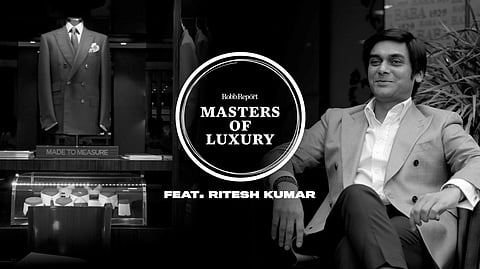
As a key member of the DS Group (Dharampal Satyapal Group), one of India’s leading FMCG conglomerates, Ritesh Kumar
plays a pivotal role in driving growth across both its core FMCG businesses and its expanding luxury portfolio. Kumar has led the group’s foray into luxury retail, representing global brands such as Tom Ford in India and overseeing the expansion of labels including Berluti and Brunello Cucinelli. In this episode of Masters of Luxury, we sit down with Ritesh Kumar to understand his take on logo-less luxury, the evolution of the luxury consumer, and more.
RK: I can only speak from my own experience as a consumer. The brands I liked in 2009 are still relevant today, and I believe they will remain relevant in the future as well. Some other brands that were relevant then are no longer so. That evolution of brands has definitely taken place. Consumption has also evolved. Especially over the last five to seven years, with the rise of social media, consumers now have much more knowledge.
RK: Honestly, I didn’t even know what the concept of quiet luxury was when I started. I’m not a very logo-driven person, which is why I like these brands; they aren’t heavily logo-led. We do get requests from clients at times asking for something more logo-centric. Commercially, brands like Tom Ford have evolved slightly in that direction, but Cucinelli, Berluti, and Brioni are still very quiet.
That, ultimately, is a personal choice. As I mentioned earlier, there is still a lot of evolution left in India from a consumer standpoint. The idea of logos is often linked to showing off, whereas luxury doesn’t need to be loud to be enjoyed or worn. That understanding is still developing. Even in parts of Europe, this evolution is ongoing, though it is further along. In India, however, we still have a long way to go in our luxury journey.
RK: Consumption is now happening in tier-two cities as well. From a customer standpoint, people in these cities have the purchasing power to buy luxury, and because they travel frequently, they are already buying luxury abroad. The challenge is access. Apart from travelling to Delhi, Mumbai, or other metros, or ordering online, there isn’t much opportunity to experience these brands locally. From a tier-two city perspective, online will play a significant role in the future.
In terms of consumption and spending capacity, there has been a clear evolution over the last ten years. Earlier, luxury was largely confined to Delhi and Mumbai. Now, cities like Ahmedabad, Indore, and Chandigarh are emerging as strong luxury pockets.
RK: For me, it’s not very brand-driven. I focus on construction, fabric, and fit.
RK: There are some mid-category, niche brands from France and Italy that I wear and buy occasionally. In fact, we’re trying to bring one or two of them to India because we believe there could be a market for them here. One such brand is Boglioli. It offers excellent fabric and construction, is entirely made in Italy, and sits at a very compelling price point.
RK: This is purely a personal view; I don’t have any formal study to back it up. Internationally, e-commerce is an integral part of the system, but if you look at the economics of it, especially in Europe, it’s challenging. The returns process is expensive, yet brands can’t ignore e-commerce because it has become essential. From a luxury e-commerce perspective, it’s very category-specific. Some products I’m comfortable buying online, while others I prefer to view online but experience in person. That’s the approach we want to take, allowing customers to browse and select online, while offering a more personalised service where they can experience the product at home or wherever they are.
RK: For me, luxury is about experience and freedom, having no hang-ups. Being able to do what you want, freely, as long as you have the ability to do so. From a product standpoint, luxury is about the experience and the product itself. But at its core, luxury is having a free mind, the freedom to choose and live on your own terms.
