
Subscribe
Subscribe
- Motoring
- Style
- Home & Design
- Travel
- Food & Drink
- Specials
- News & Tech
- Videos
There was a time when Indian celebrities making it to the front row at fashion weeks left the internet gaga. Today, the story has changed; it is now about how increasingly they are being folded into the business of luxury itself.

That shift did not begin yesterday. If anything, Aishwarya Rai Bachchan was one of its earliest architects. Long before the current crop of global ambassador announcements, she had already laid the foundation for the future by becoming one of the first Indian women to be signed by international beauty giant L’Oreal Paris in 2003, and showing up at Cannes year after year.
In June 2026, JW Marriott named Aishwarya Rai Bachchan its global brand ambassador — the first Indian face to hold the role for the Marriott Bonvoy property, which currently operates over 130 hotels worldwide. She will front the brand's "Stay in the Moment" platform across film, print, and digital campaigns internationally, and will participate in curated brand experiences in India and select global markets.
If Aishwarya opened the door, Deepika Padukone sashayed through it. Her Louis Vuitton appointment in 2022 was one of the clearest signs that the old hierarchy had shifted. She was not merely attending shows or borrowing gowns anymore - she was now being folded into the image architecture of one of the world’s most powerful houses. Her Cartier appointment that same year only reinforced the point.
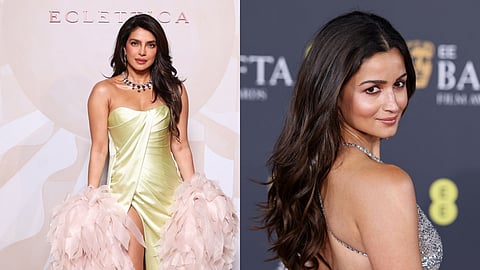
Alia Bhatt’s Gucci role belongs in the same league. Gucci named her its first Indian global ambassador in 2023, and the appointment felt entirely in step with the times. Alia represents a newer, younger kind of luxury consumer, one who is less formal and distant.
Sonam Kapoor’s Dior appointment, which was announced in 2024, made similar sense for slightly different reasons. Sonam has long had fluency in fashion that went beyond celebrity dressing. The ambassador title simply formalised what the industry already knew: that India now has stars who can move through global luxury not as novelties but as interpreters.
And no story on global fashion can be complete without speaking of Priyanka Chopra Jonas. The global icon, of course, now sits in a category of her own. She has the kind of cross-border recognisability that luxury brands have always prized, but what is striking now is how naturally she occupies the uppermost tier of global luxury storytelling.
At Bvlgari, she is not merely wearing the jewels; she is woven into the brand's mythology, from high jewellery campaigns to Jaipur-set narratives around colour, gemstones, and Roman glamour. Bentley has named her its global brand ambassador. And now, with Rolex confirming her as a Testimonee in cinema — joining James Cameron, Leonardo DiCaprio, Zendaya, and Martin Scorsese — Priyanka becomes one of the very few global personalities to hold concurrent ambassador positions for two of the world's most prestigious luxury maisons across distinct categories: Bvlgari for jewellery, Rolex for watches.
Similarly, in a fresh announcement, Nora Fatehi has been appointed as global brand ambassador for Jacob & Co. further illustrating the shift. Known for its role of high watchmaking, jewellery craftsmanship, and spectacle, the brand has positioned Fatehi as a global face rather than a market-specific representative.
To mark the partnership, she was seen wearing the Brilliant Skeleton Northern Lights, a fully skeletonised, diamond-set timepiece valued at approximately USD 83,600. Together, the appointment and the watch reflect how Indian talent is increasingly becoming part of luxury’s global narrative.
This says something useful about the current moment: Indian faces are no longer being slotted into one vertical. They are being featured across fashion, jewellery, beauty, hospitality, automobiles, and now the upper reaches of Swiss horology — indeed, the full spectrum of the global luxury lifestyle.
Ananya Panday becoming Chanel’s first brand ambassador from India last year matters because Chanel is not a house given to casual appointments. It tends to move carefully, especially when naming someone as emblematic of a market. That it chose an Indian actor now says something not only about her, but about India’s place in the luxury imagination.
But the rise of Indian representation in luxury is no longer confined to Bollywood stars with blockbuster visibility and couture-friendly publicists. Bhavitha Mandava opening Chanel’s Métiers d’Art 2026 show in New York was a symbolic moment, not just a viral fashion one. She has since been named Chanel’s first Indian House Ambassador, which moves the conversation from celebrity endorsement into the more coded world of fashion legitimacy.
Bhoomika Yadav, the 19-year-old girl from Raipur to walk for Chanel in Paris, belongs here too, even though she did not arrive with a splashy ambassador announcement. Fashion often changes in this quieter way first. The face appears, then reappears, and one day the system no longer feels complete without it.
Triptii Dimri sits at a slightly different edge of the premium image economy. Her Victoria’s Secret role is not luxury in the old French-maison sense, but it belongs to the broader universe in which beauty, sensuality, and brand mythology now travel globally.
Baume & Mercier’s recent appointment of Janhvi Kapoor as Friend of the Maison adds another layer to this shift. It signals a continued expansion of how global luxury brands are structuring their relationships with Indian talent, beyond traditional ambassador roles.
The men have taken longer to settle into this world, but they are there now. Ranveer Singh helped make masculine flamboyance legible in Indian luxury culture. He made everything, from jewellery for men and colour to theatrical tailoring, and the refusal to confuse elegance with restraint seemed fashionable. As brand ambassador of JBL, he is now making his mark on the global circuit.
And while Diljit Dosanjh may not belong in the ambassador category yet, he does belong in this story. At the 2025 Met Gala, he arrived as a man proud of his Punjabi heritage in a custom Prabal Gurung outfit, with jewellery from iconic fashion house Cartier.
It would be easy to read all of this as a soft-power win and leave it there, but luxury rarely moves on sentiment alone. The deeper explanation is commercial, and India is increasingly impossible to ignore. Reuters reported in March that India’s luxury goods market was estimated at $12.1 billion last year. It’s still small relative to China, but it is growing fast enough to feature in the global luxury conversation. Euromonitor, cited separately by IBEF, projected a 10 percent growth for India’s luxury market in 2025.
This is where the old hierarchy in luxury image-making begins to wobble. For years, Indian fashion’s relationship with the global luxury system was caught between imitation and exoticism. We were either aspiring upward or being mined for craft, colour, embroidery and “inspiration”.
What is happening now feels more reciprocal. India is not just supplying motifs, artisanship, and wedding spending. It is supplying faces, taste, fandom, and market authority.