
Subscribe
Subscribe
- Motoring
- Style
- Home & Design
- Travel
- Food & Drink
- Specials
- News & Tech
- Videos
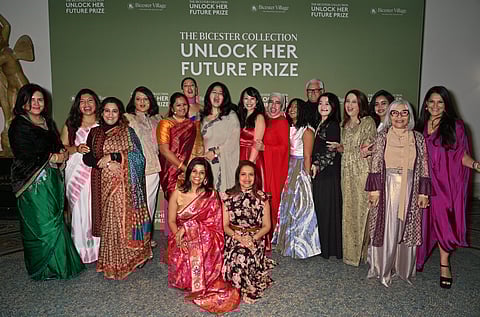
As temperatures continued to drop at an alarmingly freezing rate, a motley group of entrepreneurs, artists, ambassadors, philanthropists, and journalists dressed in vibrant shades, gathered inside the stone walls of the Battersea Arts Centre, London on November 19, 2025, to celebrate the six winners and 11 finalists of the South Asia chapter of Bicester Collection’s 2025 Unlock Her Future Prize.
The Bicester Collection—owner of 12 bespoke designer outlet villages across Europe, China, and the US—first launched the prize in 2022 to identify and empower female social impact entrepreneurs from a different global region every year. Part of the Collection’s Do Good programme, the prize is a case study in a fashion retail group’s fearless championing of female-led social impact that rests atop three pillars, comprising long-term charity partnerships, advocacy, and purpose-driven innovation.
While the prize’s first two editions focused on Latin America, the Middle East, and North Africa, its third chapter turned the gaze towards South Asia, inviting participants India, Pakistan, Bangladesh, Sri Lanka, Nepal, Bhutan, and the Maldives.

“There are challenges relating to well-being, gender equality, gender violence that still plagues the region. We hope this prize helps these women entrepreneurs scale their businesses sufficiently, to make an actionable impact on their society,” says Chantal Khoueiry, chief culture officer at the Bicester Collection’s parent company, Value Retail.
The winners of this year's edition received a USD 1,00,000 grant each, along with a week-long training in leadership and mentoring from leading female entrepreneurs from the region. These six winners, shortlisted from over 2,900 applicants, will receive a 12-month long mentorship from Ashoka (a global network of social entrepreneurs) and academic support from the Said Business School, University of Oxford.
The 11 finalists from the region are all leading social-impact initiatives that align with a United Nations Sustainable Development Goal, and reflect one of the following three key themes: health and well-being, financial inclusion and economic empowerment, and climate and sustainability. This includes a series of initiatives that range from providing improved menstrual healthcare to women to using artificial intelligence to improve education systems for children on the autism spectrum.
“All the initiatives and business pitches had the unique quality of wanting to serve the community,” says Paroma Chatterjee, CEO of Revolut India and one of the judges for this year’s prize. “Throughout these pitches, there was not a single dry eye left in the room, and they all met our overarching criteria of spotlighting female entrepreneurs who are not just unlocking power for themselves and stepping into their element, but are also allowing other women around them to step into their element.”
“The money that comes with this prize facilitates change, but the support network of this sisterhood is the real takeaway,” said Desiree Bollier, chair and global chief merchant of The Bicester Collection, and also one of the judges. “The aim with this prize is not to just create a meaningful initiative, but also a sisterhood.”
Amritha Krishnamoorthy, founder of the Bengaluru-based Stepping Stones Centre, and one of the two Indian winners of the night, is dedicated to transforming education and therapy for children with autism and developmental disabilities. Post the ceremony, she shares, “I want to scale this business enough so that neurodivergence as an issue can stop being an individual problem for families affected by it. I want to help build a society that starts seeing this as a collective responsibility.”
Jhillika Trisal, founder of the Delhi-based Cognitii, and one of the winners of the night, also spoke on the possibility of working with her fellow finalists in the future. As someone who lives with neurodivergence herself, Trisal’s company works towards democratising access to quality education for children with special educational needs by combining AI with human special educators. “It is a sisterhood that I have entered and we all need to work together,” she says. “While Amritha and I are in similar sectors, she is working on the end product, and I am working on the service design for that product. There is way too much for all of us to learn from each other, and I cannot wait for what the year has to bring.”
Parallely, Khoueiry adds, “Every year we implement our learnings from the previous year into the next edition of the prize. One of the most important take-aways from this year has been the need to establish an alumni network that these women can access and fall back on at any given point. We aim to consolidate this further, as we move towards our next edition in the South-East Asian region.”