
Subscribe
Subscribe
- Motoring
- Style
- Home & Design
- Travel
- Food & Drink
- Specials
- News & Tech
- Videos
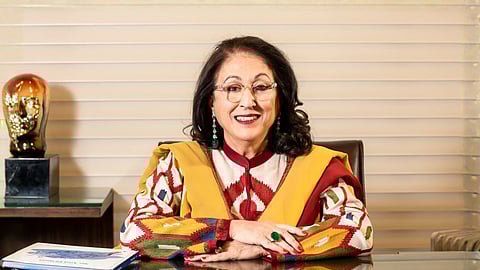
Kiran Nadar's philanthropic work in art and education hardly needs an introduction. But as we spotlight stories of impact this season, hers is one we cannot overlook. We speak with her about what philanthropy means to her, what it has taught her, and how she views India's position on the global giving index.
Kiran Nadar: Philanthropy is more critical now than ever. In a country like India, with vast inequalities, social divides, and a rapidly changing economy, those who are privileged have not just an opportunity, but a responsibility, to contribute meaningfully. True philanthropy can help bridge educational, cultural, and social gaps and provide access to opportunity to those who might otherwise never have it.
KN: India has a long cultural legacy of giving, yet our formal philanthropic ecosystem is still evolving. To strengthen it, we need to build greater awareness, transparency, and trust around institutional giving. Philanthropy must go beyond one-time donations and move towards sustained, long-term commitments that create measurable social impact. Encouraging families and individuals to think intergenerationally, to build institutions rather than short-lived initiatives, will be key.
At the same time, we must nurture a culture of participation across all socioeconomic groups, through volunteerism, community-led action, and accessible avenues for contribution. Public–private partnerships, enabling policies, and collaborative frameworks can significantly amplify the scale and reach of philanthropic work. Ultimately, boosting philanthropy in India will require both structural support and a mindset shift, where giving becomes a shared national value.
KN: Education has always been a deeply personal commitment for my family. Through the Shiv Nadar Foundation, I have seen how transformative it is when a young person, often the first in their family to access quality education, discovers their own potential. That journey has been incredibly moving. Equally, art has been a lifelong passion of mine, and the creation of the Kiran Nadar Museum of Art grew from a very personal desire to share that passion with the wider public. I want people from all walks of life to feel a sense of belonging within museum spaces, to encounter art not as something distant or elite, but as a living narrative that resonates with their own experiences.
My intention with KNMA has always been to democratise access to culture and to position the museum as an educational and civic space, where learning happens through enquiry, dialogue, and reflection. At KNMA, art itself becomes a powerful tool of education, fostering critical thinking and encouraging visitors to explore ideas, histories, and perspectives beyond their immediate surroundings. Ultimately, the work is about opening doors and widening horizons, ensuring that every individual, regardless of background, is afforded the dignity of cultural access and the opportunity to imagine new possibilities for themselves.

KN: Philanthropy for me is about building institutions, creating opportunities, empowering individuals, and ensuring sustainability. It’s about giving people a chance to realise their potential, to rise, to dream, and to contribute back. It’s also about nurturing culture, art, knowledge, and values, because a society isn’t judged only by its economic progress but by its humanity, creativity, and inclusivity.
KN: Philanthropy has taught me humility, patience, and long-term thinking. It has reinforced the belief that systemic change, in education, culture, and social mobility, doesn’t happen overnight, but through consistent effort, well-designed institutions, transparency, and accountability. It also taught me that real giving is about impact on lives, often in ways unseen, but real and lasting.
KN: I hope my legacy is defined by institutions that endure and continue to enrich society long after I’m gone. With KNMA, my intention has always been to build a truly world-class cultural institution, one that stands at par with global museums while remaining deeply rooted in India’s own artistic traditions. I envision KNMA as a space that belongs to everyone: where young people first discover creativity, where families feel welcome, where students are exposed to new ideas, and where artists find recognition and support. My hope is that the museum grows into a lasting public institution that evolves with the times, reflects India’s many voices, and remains a hub of learning, dialogue, and inspiration for generations.