
Subscribe
Subscribe
- Motoring
- Style
- Home & Design
- Travel
- Food & Drink
- Specials
- News & Tech
- Videos
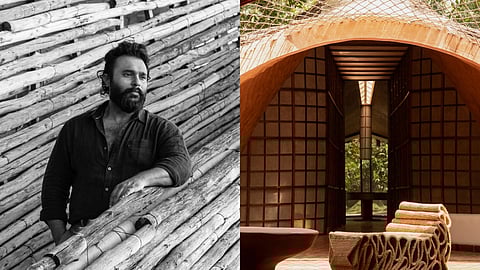
Vinu Daniel’s architecture begins with a question. After working on post-tsunami reconstruction with the Auroville Earth Institute for the United Nations Development Programme (UNDP), he returned to set up Wallmakers, an architectural practice in Kerala that crafts dreamlike, site-responsive spaces using the earth and waste strewn across urban landscapes. Renowned for his sustainable, cost-effective innovations, Daniel is pushing architecture to ask a harder question: not “What should we build?” but “Should we build?”
The turning point, he reflects, came early on: “The journey started with a chance meeting with celebrated architect Laurie Baker, who shared an incredible insight into his world. It changed my attitude towards architecture,” he tells Robb Report India.
What followed—from Auroville in 2005 to researching on waste as a building material in India’s expanding cities—has been a practice rooted in years of observation, adaptation, and an unwavering commitment to building responsibly.
Wallmakers gained international recognition by winning the Royal Academy Dorfman Award in 2022 for its inventive and ecologically sensitive projects.
In an interview with Robb Report India, Daniel speaks about his journey and inspirations, and debunks some misconceptions in the world of architecture.
Robb Report India (RRI): What has your journey been like so far?

Vinu Daniel (VD): The journey started with a chance meeting with Laurie Baker, a British-born architect and pioneer of sustainable architecture, who shared an incredible insight into his world with me. That half-day experience proved to be life-changing. I started noticing my surroundings.
In 2005, I visited Auroville to learn more about eco-friendly architecture. The journey from there has been all about constantly noticing my surroundings, observing the people who are part of our community, and adapting our process accordingly. Once I started working in more urban areas, I observed that there was a lot more waste strewn around than we had imagined. I began researching its potential as a building material and developed our own techniques.
RRI: You showcased at India Design ID 2026. How do such initiatives help shape the future of Indian architecture?
VD: Platforms that encourage conversations on the current issues our fraternity is facing are always the right way to go.
RRI: The common belief is that luxury cannot be sustainable or inexpensive. How do you counter that narrative? Take us through the process of your work.
VD: There has long been a misconception that sustainable and eco-friendly materials cannot look good, and that buildings made with them cannot be luxurious; that they must be limited to being “a poor man’s material". But why should even a poor man be deprived of aesthetics? And why can’t buildings made with sustainable materials have the same comfort and luxury as conventional buildings?
RRI: What are the biggest challenges you face, especially working here in India?
VD: Misconceptions regarding the durability and strength of mud blocks and the other alternative sustainable techniques we practice.
RRI: Apart from Laurie Baker, where else do you draw your inspiration from?
VD: Antonio Gaudí and Louis Kahn have really inspired me.
RRI: What role does AI have to play in the future of urban architecture? Do you think it will help or affect the way Wallmakers integrate new, evolving techniques?
VD: AI is not a creative tool, and it’s wrong to expect it to do our job. So no, I don’t think AI can help in our process of developing new techniques or designs.
RRI: One motto or quote you live by?
VD: Construction is a sin! Build diligently.