
Subscribe
Subscribe
- Motoring
- Style
- Home & Design
- Travel
- Food & Drink
- Specials
- News & Tech
- Videos
AI generated summary, newsroom reviewed
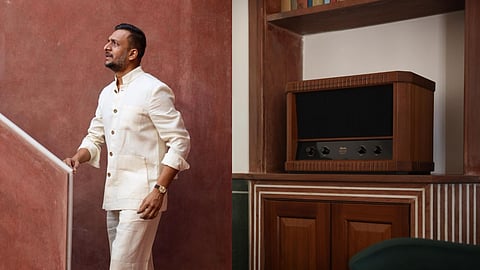
Gazing at his grandfather’s radio fired Diwik Singh Chhalani’s imagination to bring it up to speed while retaining its essence. He gathered a few handpicked craftsmen and local artisans to help bring his vision to life — and this became the core team behind every Diwik's creation that finds a home in a collector's home. “The exploration quickly moved beyond a one-off. We began building our own sound systems using reclaimed Burmese teak from old havelis across Rajasthan. From there, it became a natural coming together of sound and craftsmanship, using their skill to create timeless objects,” he notes.
From that early experiment, Diwiks expanded steadily into what is now an established proposition in Indian luxury audio. Each system is built around transducers by SEAS Fabrikker — the famous Norwegian specialist manufacturer — hand-assembled crossovers featuring Polish components and Class-D amplification from Taiwan. All of this comes together at Studio Kasturi Kraft in Bikaner under the supervision of expert consultants, sound engineers from Mumbai, and Chhalani himself.
One would assume that orchestrating this multi-lingual collaboration between traditional artists and nerdy engineers would be challenging, but Chhalani makes light of it. “It is less of a struggle and more of a recalibration. The assumption is that the gap is large, but it is not. Precision already exists in their work; it just needs to be redirected. Carpentry, much like music or any specialised skill, is scientific and universal. Two musicians from completely different backgrounds can jam together with just a bit of tuning. It is a bit like that.”
Purists would probably be curious about the acoustical design of the cabinet, considering its form is a custom concoction of mid-century aesthetics, reclaimed Burmese teakwood and high-performance speakers. “The cabinet is built to serve the sound. Internal volume, damping, and resonance control — all come first. The exterior follows. Our craftsmen are not working on something traditional in their minds. They are executing something precisely. The technology does not see nostalgia either. It responds to the enclosure design.”

The men shaping the wood carry their own extraordinary histories. Ustad Mainuddin's ancestors were among the very first karigars of Bikaner who migrated from Iran in the 16th century and were responsible for building the foundations of the city itself. He himself has worked on varied projects like havelis to vintage trains and cars, but even at 65, he approaches every new commissioned project with the same experimental curiosity.
Manoj Suthar literally has carpenter in his name and represents the fifth generation of a family of Suthars, the traditional woodworking community. His work involves seamless joinery and inherited precision that is channelised into the exacting demands of the Diwiks enclosure design.
This makes for a unique predicament in the normal business sense that only 15 Diwiks units can be produced annually, but Chhalani sounds determined by adding, “The limitation is not strategic. It is a consequence of how things are made. Every cabinet, every crossover, every internal decision requires a certain level of involvement. That does not allow for speed. If something larger comes along, it would still have to respect this way of working. Otherwise, it does not make sense to pursue it.”
As a function of its artisanal manufacturing process, it is also not a marketing stunt to artificially create more demand. “There is genuinely no attempt to create scarcity. The waiting period is simply the flow of orders and the pace of production. Each commission begins with a conversation, and we proceed once there’s alignment. The process itself is unique, with each piece being made one at a time. Proportions, finishes, internal configuration — nothing is taken off the shelf, yet we want to deliver the same sound each time”, he clarifies.
High-end brands also tend to have a ‘house sound’, but with no formal assembly line or standardisation in cabinet volume, we were curious about the sonic signature that Chhalani is aiming for. “The sound is not exaggerated. It is not tuned to impress in the first few minutes. It is meant to hold over time. Balanced, intimate, calm, and has its quiet confidence in tact. Something you can sit with for hours without fatigue. Instead of demanding attention, it is rewarding,” he assures us.
There definitely is an element of emotional and architectural statement that a Diwiks makes in a room. Chhalani emphatically retorts, “It is true that each piece becomes personal, even emotional, given how long we stay involved with it. But the idea is not to make a statement for the sake of it. It should belong to the home. It becomes part of the buyer’s life and their story. Our role ends with delivering it, and it begins its own journey.”
Where does he see the brand in five years? He is disarmingly unbothered by the question. "The focus is to stay with the work and keep refining it. Somehow, the best things have always happened on their own. If something made today is still being used and cared for years later, that feels enough.”
In an era where black boxes and generic audio equipment have become all too common, Diwiks provides a soulful alternative. Chhalani wants to bring back a way of making where things are done well, with attention to detail, high quality, and a certain quietness to it. “Not everything needs to be visible to be valued,” he says. As an emotional heirloom, this is a triumphant statement piece for any home.