
Subscribe
Subscribe
- Motoring
- Style
- Home & Design
- Travel
- Food & Drink
- Specials
- News & Tech
- Videos
While one might have their eyes peeled on the usual auction sites for the most exclusive collections, at times they take place at the most unassuming of places. For instance, quietly behind government doors, observed only by a handful of officials and close contacts. One such repository is India's Toshakhana, the treasury of the Ministry of External Affairs for diplomatic gifts received by the country's highest constitutional authorities.
In a matter of firsts, the Ministry has opened this collection to the public through an auction featuring nearly 300 objects, providing collectors with an opportunity to acquire pieces that have travelled the corridors of international diplomacy before finding a seat in government custody.

The toshakhana is the official repository where gifts received from foreign government dignitaries by the President, Prime Minister, Union Ministers and other high ranking officials are securely deposited. The concept derives from Persian and during the Mughal era used to be rooms where princes stored precious gifts and objects of status and honour.
Under the Government of India's Toshakhana Rules, such gifts are taken by default to be government property. Officials with hopes to retain a gift that is beyond a prescribed value are expected to pay its assessed price.
Whereas toshakhana has long existed as an administrative institution, for instance, the toshakhana of the Golden Temple are a richly bejeweled canopy, and a chandoa (a diamond-encrusted piece of cloth hung over the Guru Granth Sahib), it rarely becomes visible to the public eye. This particular auction marks the first time—after 1983 when the last auction was held, limited only to government officials of MEA—that the Ministry has opened its doors to the general public to come and bid for its diplomatic gift collection.
Once you look at the contents of the auction you realise it's far from being a collection of ceremonial souvenirs. Among the highlights are two Rolex Yacht-Master II watches, with bidding starting from Rs. 16.5 lakh.
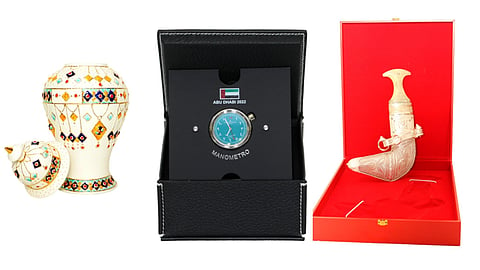
Collectors of decorative arts will find objects of interest as the list includes affairs like a silver tea set crafted in London and an Omani silver dagger. One of the most talked about items in the lot is an antique silver box, believed to have entered the toshakhan in the 1980s and originally designed to be a luxury cigar or a cigarette case. Offered at a base price of Rs. 12,030, it has already garnered about 30 bids, pushing its value up to Rs. 52,000.
Some other highlights entail a decorative silver box flanked by two gold-plated dragons containing a 20-gram fine gold biscuit produced by Swiss precious metals refiner Argor Heraeus. It entered the auction with a starting price of Rs. 3.92 lakh and has already surged to Rs. 4.06 lakh.
At the higher end of jewelleries sit a gold necklace, bracelet and earrings set by Kuwait's Al Arbash, priced at Rs. 9.5 lakh.
In the lot, these fine collectibles are also not the limit. Apple MacBook Pro presented to officials during overseas engagements take the list towards high-tech.
Overall, nearly 300 items make up the lot with prices ranging from Rs. 2,385 to Rs. 17 lakh.
Unlike conventional collectibles, these objects derive much of their worth and significance from the bureaucratic context in which they are set. It is not a secret that diplomatic gifts are carefully chosen—curated even—to represent a nation's culture, craftsmanship or artistic heritage. A handcrafted carpet, an engraved silver service or a ceremonial weapon is often as much a cultural marker as it is a formal present.
Viewed together, the collection makes for an informal archive of India's international engagements. The catalogue reveals the remarkable variety of objects that have quietly accumulated through state visits over the decades.
The Ministry has stated that the auction is intended to dispose of surplus inventory while generating revenue for the government.
Government sales of diplomatic gifts are exceptionally uncommon, particularly in India. Unlike objects entering the market through private collections or estate sales, every lot originates from an official diplomatic exchange before passing into the custody of the Ministry of External Affairs.
That provenance is likely to appeal to collectors of horology, decorative arts and diplomatic memorabilia alike. While the identity of the original Indian recipient is not disclosed, each object forms part of the country's official record of state hospitality.
For luxury collectors, the attraction extends beyond brands such as Rolex. The sale offers authenticated objects with documented government provenance—pieces that have already lived one remarkable chapter before beginning another in private hands. It is a rare instance where collecting intersects not merely with craftsmanship, but with the quiet theatre of international relations.
FAQs
What is the Toshakhana, and what did the MEA recently announce?
The Toshakhana (from the Persian words for "treasure" and "house") is the official repository for gifts received by Indian public functionaries from foreign governments and dignitaries during official engagements.
What items are up for auction?
The auction features nearly 300 ceremonial gifts, including luxury watches, gold jewellery, silver artefacts, heritage collectibles and diplomatic souvenirs. Standout items include:
Rolex Yacht-Master II Watches
Ballon Bleu de Cartier Watch
Cartier Limited-edition Fountain Pen
Sterling Silver Tea Set
What is the timeline for this auction?
The e-auction began on June 8, 2026, and remained open for bidding until 5 PM on June 30, 2026.