
Subscribe
Subscribe
- Motoring
- Style
- Home & Design
- Travel
- Food & Drink
- Specials
- News & Tech
- Videos
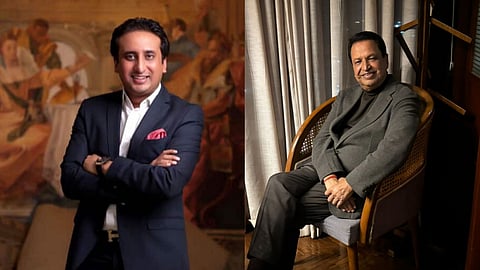
Serving as the managing director and CEO of Nepal’s illustrious CG Hospitality, the hospitality arm of the multinational Chaudhary Group, Rahul Chaudhary represents the fourth generation of a 140-year-old family enterprise. Founded by his father, Binod Chaudhary — Nepal’s first billionaire — it is a global portfolio of more than 230 hotels and resorts across multiple countries, in partnership with international brands such as Hilton and Marriott. Recognised as one of the most influential hoteliers in India, Rahul is steering CG Hospitality towards ambitious expansion by 2030, blending global scale with regional identity, while building on his father’s reputation as a formidable deal-maker.
Robb Report India chats with the father-son duo about scaling a legacy business across continents, the art of the deal, and what the future of luxury hospitality looks like in a rapidly evolving world.
Rahul Chaudhary (RC): We operate in 12 countries, including Nepal, and luxury in hospitality has evolved significantly. It’s no longer about marble and chandeliers. True luxury today is simplicity that endures bespoke, memory-making moments that stay with guests long after they leave.
At one of our resorts, Meghauli Serai, A Taj Safari in Nepal, a guest once told us their most vivid memory was sipping morning tea from a clay matka as the sun rose over the jungle. That humility — the local touch, the ritual, the sincerity of service, the quiet attention to detail — stitches the product into something regenerative and timeless. We’re not selling a bed; we’re selling experiences. For us, luxury is also intergenerational, something you design and steward so future generations of guests and staff inherit it whole.

RC: Leadership philosophies naturally evolve. My father, Dr Binod Chaudhary, belonged to a different era — one defined by instinct and bold risk-taking. He didn’t have armies of analysts or consultants. He learned businesses firsthand, experienced their realities, and made decisions based on judgment and hard-earned knowledge.
Today, we are fortunate to have access to deeper resources and seasoned professionals. That hasn’t reduced our appetite for risk — we remain risk-takers — but it has broadened how we evaluate and shape opportunity. We’re focussed on building CG (Chaudhary Group) as a global brand and CG Hospitality as a platform that brings the world to Nepal and showcases Nepal to the world.
Being a Nepali brand is both a strength and a challenge. Our origin gives us authenticity and a unique voice, even if domestic conditions haven’t always supported our ambitions. Still, we’ve expanded internationally and widened our footprint. We think generationally: Building a company that endures, modernises with care, and respects legacy. Succession is not a handover; it’s a long conversation about values, stewardship, and measured ambition.
RC: It’s both. Nepal’s assets — from the highest peaks and the birthplace of the Buddha to rivers, forests, and wildlife — are inseparable from living cultures. Our diverse communities, crafts, languages, and rituals carry meaning that must be sustained.
Hospitality requires operational discipline, but also responsibilities of preserving heritage, supporting local artisans, protecting ecosystems, and creating meaningful engagement between guests and the place. When business and efficient management reinforce each other, we safeguard culture while offering a deeper, more responsible way to travel.
BC: Foreign investment is not the risk — uncertainty is. If Nepal intends to compete meaningfully on the global stage, it must welcome capital while protecting ecological and cultural integrity. Investors require stability and predictability. In just over three decades, Nepal has seen nearly thirty governments. Long-term investment cannot function in short political cycles.
When investors feel safe, supported, and valued, capital flows naturally. Tourism is a clear example. Nepal currently welcomes roughly one million visitors annually. With better infrastructure and destination diversification, we could host significantly more — not through reckless volume, but through high-value, well-regulated growth.
RC: Design integrity, operational stewardship, and Nepal’s cultural narrative are all non-negotiable. The work is to ensure partnerships are collaborative, not competitive — combining global expertise with local insight. The best outcomes come from co-creation, not control.
RC: Quiet luxury aligns naturally with Nepal’s temperament. The challenge is execution: It requires trained teams, strong systems, and a shift toward valuing nuance over spectacle. The opportunity lies in investing in talent, local craft, and place-based experiences.
BC: We are home to five of the world’s tallest peaks, yet our tourism story remains too narrow. Beyond Everest, regions such as Dolpo, Mustang, and Rara remain under-positioned globally. With thoughtful infrastructure and premium positioning, Nepal can evolve from expedition tourism into a more sophisticated, experience-led economy.
Nearly 60 percent of our land is forested. We have valuable medicinal herbs, rich mineral resources, and extraordinary biodiversity. Nepal has an estimated 80,000 megawatts of hydropower potential, yet only a fraction has been harnessed.
Culturally and spiritually, Nepal holds immense capital — Lumbini, the birthplace of the Buddha, and sacred Hindu sites such as Pashupatinath. Few countries combine geographic drama, biodiversity, and spiritual depth so organically.
The issue is not a lack of assets. It is execution.