
Subscribe
Subscribe
- Motoring
- Style
- Home & Design
- Travel
- Food & Drink
- Specials
- News & Tech
- Videos
There are hotels that use design as decoration — a statement chair here, a gallery wall there, a tasteful lamp angled just so. And then there are hotels where design is the point of entry. Here, architecture is not a backdrop but the very definition. Across the world, a new generation of travellers is going beyond just five-star service to seek a stronger sense of place and point of view. From a Frank Gehry fantasy rising out of Rioja wine country to a Bauhaus-rooted boutique hotel in Washington, DC, these are the properties where the stay is as much about looking as it is about lounging.

Best for: Moorish grandeur with old-world theatre
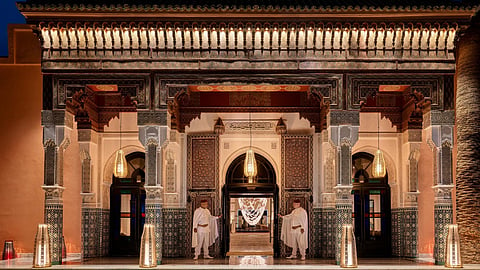
Few hotels understand drama quite like La Mamounia. Set within gardens gifted to Prince Moulay Mamoun in the 18th century, the Marrakech grande dame has long existed in that delicious space between palace, myth, and stage set. Its design language is unmistakably Moroccan, but never museum-like. Zellige tilework, carved cedar, tadelakt walls, arches, courtyards, lantern light, and shadowed corridors come together in a way that feels cinematic.
Patrick Jouin and Sanjit Manku’s renovation, carried out in phases ahead of the hotel’s centenary, reworked several public spaces while preserving the property’s original character. The result is maximal in the most intelligent way — layered, perfumed, patterned, and unapologetically glamorous.
The showpiece is the centenary chandelier in the main lobby, inspired by traditional Berber jewellery and imagined almost like a monumental heirloom. Suspended at the heart of the hotel, it captures what La Mamounia does best: Turn craft, memory, and spectacle into atmosphere.
Best for: Bauhaus bones, boutique polish, and capital-city cool
Washington, DC is not the first city that comes to mind when one thinks of design-forward hotels. SIXTY DC changes that conversation. Set in Dupont Circle, the 73-key hotel takes its cues from the Bauhaus architecture of its existing building, then warms it up with wood, leather, brass, and a cosmopolitan sensibility that feels more private club than buttoned-up capital stay.
The design, developed with Melissa Bowers, gives the property a layered character. There is a retro polish to the cocktail bar, Reynold’s; a social, city-facing energy to its dining and rooftop spaces; and a sense of considered restraint in the rooms. The result is a hotel that’s sharp, sexy, and more worldly than DC’s usual offerings.
For travellers who want to be close to Embassy Row, museums, and the city’s political theatre without sleeping inside something that feels like a diplomatic holding room, SIXTY DC is a clever new address.
Best for: Architectural fantasy in the forest
Treehotel in Swedish Lapland is what happens when childhood imagination is handed to serious architects. Located in the forest near Harads, the hotel is a collection of architectural ideas perched among trees. One cabin resembles a mirrored cube, while another looks like a UFO, a third a bird’s nest, a fourth a dragonfly, the fifth a blue cone, and so on.
The brilliance of Treehotel lies in the contrast between whimsy and rigour. These are not novelty structures dressed up for Instagram; they are carefully resolved architectural objects, each responding differently to the forest. Some disappear into it, while others deliberately interrupt it. The mirrored cube, for instance, almost dissolves into the surrounding pines, while the UFO leans fully into the surreal.
For a design traveller, Treehotel is like Disneyland. It is playful without being unserious, remote without being austere, and deeply Scandinavian in its relationship with landscape and material.
Best for: Frank Gehry drama in wine country
In the Rioja Alavesa region of Spain’s Elciego, amid vineyards and centuries-old winemaking tradition, Frank Gehry placed a building that appears to be in permanent motion. Hotel Marqués de Riscal is all titanium ribbons, sweeping curves, and sculptural defiance. If most wine-country hotels lean on rustic romance, this one chose architectural provocation.
The hotel sits within Marqués de Riscal’s City of Wine, combining Gehry’s avant-garde structure with the estate’s historic cellars and deeply rooted wine culture. Its metallic canopy — often read as an abstracted expression of wine, bottle, and foil — turns the landscape into theatre. Inside, the rooms are calmer but still distinct, with Gehry’s sculptural sensibility appearing in furniture, material choices and spatial gestures.
This is the place for those who like their vineyard stays with a side of architectural audacity. You come for the wine, certainly, but also for the thrill of waking up inside one of the world’s most recognisable design signatures.
Occupying the upper floors of The Otemachi Tower, Aman Tokyo translates the language of a ryokan into a vertical urban sanctuary. The scale is grand — the lobby rises like a temple in the sky — but the feeling is controlled, serene, and almost meditative. Washi paper, ikebana, stone, wood, engawa-inspired platforms and framed city views work together to create a rare kind of Tokyo luxury: expansive, but never loud.
Designed by Kerry Hill Architects, the hotel is often described through the lens of Japanese tradition, but its success lies in avoiding pastiche. Instead, Aman Tokyo distils elements of Japanese design — proportion, shadow, texture, emptiness — and reassembles them high above the city.
Best for: Contemporary Indian calm
Designed by Kerry Hill, The Lodhi brings together monumental scale, quiet geometry, and Indian architectural references without tipping into cliché. Jaali screens, stone, lofty volumes, private plunge pools, and shaded outdoor spaces make it feel both urban and retreat-like.
Originally opened as Aman New Delhi, the hotel still carries that design DNA: Disciplined, low-key, and deeply attentive to proportion. But there is also something distinctly Delhi about it — the way it holds privacy within density, the way its stone surfaces catch the light, the way it makes stillness feel like an achievement in the middle of the capital. For design lovers, The Lodhi’s appeal is its scale, silence, and repetition.
Designed by Olson Kundig, the resort is conceived as a low-rise, landscape-sensitive retreat, with buildings that frame the Rocky Mountain setting rather than compete with it. Wood, stone, steel, glass, and large windows allow the architecture to sit close to the land, while the interiors are residential, warm, and grounded.
Opened in late 2025, the resort marks One&Only’s first property in the United States and includes rooms, suites, cabins, and private homes across a dramatic alpine setting. With rugged modernism and elemental materiality, it is ski-lodge luxury reimagined. The key here is balance. Moonlight Basin understands that wilderness luxury works best when the landscape remains the lead character.