
Subscribe
Subscribe
- Motoring
- Style
- Home & Design
- Travel
- Food & Drink
- Specials
- News & Tech
- Videos
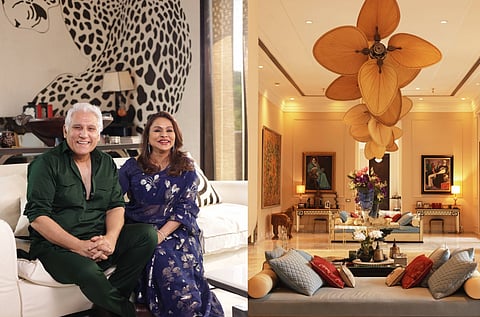
I’ve grown up in Delhi and lived in many homes—courtyard houses, double-height spaces, places where the line between the inside and outside merged,” says Raseel Gujral Ansal, architect, artist, and creative director of RGA Design. Those childhood memories wrapped themselves around Delhi’s colonial-style columns, Mughal domes, and the couple’s contemporary lifestyle, to find form in a singular architectural vocabulary that is Chaand Bagh: the serene home that Raseel shares with her husband Navin Ansal, co-founder and director, RGA Group of Companies.

A narrow Chhatarpur lane in south Delhi leads to the entrance of the farmhouse that is marked by an imposing wooden door. Inside, a flowering frangipani tree greets visitors. A marble statue of Nandi, the sacred bull recognised as the mount of the Hindu god Shiva, sits under the tree.
Further down the main pathway, a pair of marble jaguars sculpted out of white rock from Rajasthan stand guard at the entrance to the home. “They weren’t meant as statements,” says Raseel. “I simply liked them,” she adds, referring to the wild cats.
Spread over 2.5 acres, Chaand Bagh has a natural feel to it that doesn’t feel constructed and is perhaps Raseel’s most intimate expression yet: a residence where heritage and modernity seamlessly entwine.
“We are both loners,” says Raseel, referring to herself and her husband, Navin. “When we bought this land, 15 years ago, it was even further from the madding crowd. That sense of calm, surrounded by green, with not too many buildings—that’s what drew us.”
Opposite the main entrance sit three imposing 12-foot bronze figures created by the late contemporary Indian artist and recipient of the country’s second highest civilian award, the Padma Vibhushan, and also Raseel’s father, Satish Gujral, to mark her three decade-long design career. Gujral was 91 when he created the artwork that is inspired by an earlier work of his titled Man on the Unicycle. Named Trinity after Trimurti or the Hindu trinity, the artwork depicts three figures representing the powers of creation, preservation, and destruction, symbolised by Brahma, Vishnu, and Shiva.
The entrance lobby is an amalgamation of cultural influences. The floor is inlaid with an interesting goat motif rendered in mother-of-pearl and black marble. Raseel points out that the work is inspired by the wine cup of the Mughal emperor Shah Jahan. A few steps ahead, a pair of stone dogs sourced in Milan, add a touch of European sleekness. “For me, everything has to have a story,” says Raseel.
“This house has grown organically,” Navin adds. “Nothing here was bought just to fill space. Every piece—whether from Milan or Paris—was chosen because it resonated [with us]. Everything you see is part of our vocabulary, part of our being.”
The dome-shaped lobby leads into a series of rooms that include the inner lobby, the living, dining, and office areas, and veranda; each effortlessly flowing into the other. “When we host, different age groups naturally gravitate to different rooms,” shares Raseel. “After-parties often drift upstairs, once Navin calls time on the [celebrations] downstairs. [The space is] open, fluid, and organic.”
Among Chaand Bagh’s many corners, one room resonates most deeply for Raseel. Originally designed for Navin, it became her sanctuary instead. “I started watching shows here, sitting on the carpet surrounded by art. It inadvertently turned into a ‘divine room’,” she says.
The room houses several artworks including pichwai paintings (a traditional Indian textile art native to Rajasthan), lithographs by the 20th-century Indian artist Raja Ravi Varma, and a satirical work titled Money, Money, Money by the Indian contemporary artist Farhad Hussain. “Life without humour is too serious,” she says, referring specifically to Hussain’s work.
Another cherished work is a painting of a girl titled Nancy (1954) by Satish Gujral, created during his apprenticeship with the Mexican painter Diego Rivera, in Rivera’s home country. Discovered by Raseel as a teenager, the artwork holds special meaning for her, as she believes that it has seen her through every chapter in her life. “It’s a reminder of [my] heritage and continuity,” she says.
The living room opens onto gardens that flow toward the pool pavilion. “We all like to swim,” says Raseel about the 70x25-ft pool designed for serious swimmers. “The length had to be enough for proper laps.” Flanked by a guest suite, gym, and shaded veranda, the pavilion balances activity with leisure. “A lot of our younger son’s birthdays were spent there,” recalls Raseel. “Even in December when there’s fog, everyone gathers by that space.”
Once visible from the main house, the view of the pool is now softened by trees. “She wanted more shaded garden areas,” notes Navin. “Now the pool feels secluded—almost like its own resort.”
What sets Chaand Bagh apart is its emotional architecture—every design choice is anchored in feeling. Why a courtyard matters, why symmetry evokes serenity, why art should confront and console in equal measure are the key questions that have helped shape the property.
More than style, it is about nazariya—the Hindi word for perspective or a way of seeing—that defines Raseel’s practice. Her design philosophy is extended through her ateliers or studios. Casa Paradox, the first Indian design house showcased at Maison&Objet in Paris, helped provide a global platform for Indian craftsmanship. Casa Pop celebrates maximalist exuberance and Arzaani—her most personal project— is an expression of slow luxury.
One of the couple’s daughters was married on the estate soon after they moved in, making it a space for memorable celebrations. “For us, this house has been about life’s milestones,” says Navin, fondly recalling the lawns being filled with laughter during their grandson’s birthdays. “I don’t need to take a holiday. Every day here feels like one with a new flavour, a new light, a new moment,” he adds. Raseel beautifully sums up what their home means to them with the phrase: “If there’s a heaven on earth, it’s here.”