
Subscribe
Subscribe
- Motoring
- Style
- Home & Design
- Travel
- Food & Drink
- Specials
- News & Tech
- Videos
AI generated summary, newsroom reviewed
"Parks are works of art just as a painting or sculpture is," observed Thomas Hoving, the celebrated former director of the Metropolitan Museum of Art, and nowhere is this truer than in the world's great sculpture parks, where the boundary between nature and creation dissolves entirely.
Long before the phrase "outdoor gallery" entered the art-world lexicon, civilizations understood instinctively that art needed air, light and space to breathe. In Ancient Egypt, Greece and Rome, statues were woven into the fabric of gardens and public squares, standing as extensions of the world around them. By the Renaissance, Italian villas had elevated this instinct into an art form of its own. Sculpture folded into formal gardens as expressions of humanism, mythology and power became common. The grand estates of 17th- and 18th-century France and England pushed the idea further, treating sculpture as an inseparable extension of landscape design itself.
What began as a display of wealth and dynastic legacy has, over centuries, matured into something far more democratic. The 20th century saw sculpture gardens step out from behind museum walls and becoming public cultural spaces. Today, these spaces serve a purpose that is as much social as it is aesthetic. These sculptural parks preserve heritage, foster social cohesion, and offer education and identity to the communities that surround them. They integrate art with environment, negotiate scale against setting, and ask questions of preservation that a gallery interior never has to.
A sculpture park might hold the collected works of dozens of artists or the vision of a singular one. It might unfold as a formal trail through manicured grounds or wander loosely through open countryside. It sits alongside related art forms like land art, where the landscape becomes the artwork, and topiary, where plants are carefully shaped into living sculptures. What unites them all is a simple, enduring conviction, one that Francis Bacon articulated as early as 1625 in his essay Of Gardens: that a garden which is adorned, shaped, populated with art represents one of the purest and most refined pleasures human beings are capable of creating.
From ancient courtyards to contemporary parklands, sculpture gardens have always asked visitors to repect nature and to move. To experience art as one where nature and human imagination meet.
Here, we chart some of the finest sculptural parks the world has to offer.

Set beneath the shadow of its namesake mountain in the Hudson Valley, Storm King is proof that scale and stillness can coexist. What began in 1960 as a modest home for Hudson River School paintings has grown into one of America's most significant sculpture park, its five hundred acres are now home to some of the twentieth century's most towering sculptural achievements. Walk its grounds and you will notice the hush of the North Woods, the panoramic sweep of Museum Hill overlooking Moodna Creek, the open theatre of the South Fields.
Monumental works by titans of modern sculpture rise from the meadows like geological formations. There is something radical about encountering art this size in a landscape this vast as the works don't dominate the land so much as negotiate with it. Storm King is a place to wander, to let the topography reveal its sculptures gradually. Few places make the case so persuasively that landscape and sculpture were always meant to be read together.
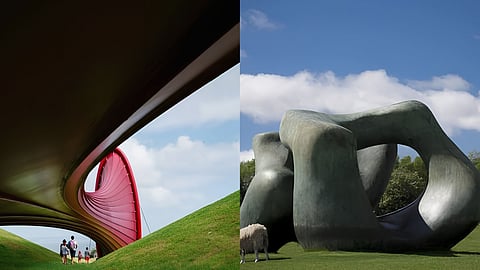
When it opened in 1977 on the grounds of the eighteenth-century Bretton Hall estate, Yorkshire Sculpture Park became the first of its kind in Britain. This was a direct descendant of the open-air exhibitions that London's parks had hosted decades earlier which was now given a permanent, rolling grounds of its own. Across five hundred acres of historic parkland, the park holds an enviable roster of British sculptural giants with Henry Moore and Barbara Hepworth chief among them and their bronze and stone forms settling into the Yorkshire hills as though they had always belonged there.
Unlike many sculpture gardens that fix their collections permanently in place, its "gallery without walls" reinvents itself through a rotating exhibition programme, ensuring the landscape is never quite the same twice. Follies and architectural traces from the estate's eighteenth-century past linger among the contemporary works, lending the whole site a layered outlook. Under its recently appointed leadership, the park continues to expand its ambitions. It remains, above all, a place where the English countryside and modern sculpture seem to have reached an easy, enduring understanding.
Nowhere does one artist's vision dominate a public landscape quite like it does at Frogner Park. Norway's largest and most visited green space is, at its heart, a single sculptor's life's work, the Vigeland installation. It houses 212 bronze and granite figures carved entirely by Gustav Vigeland across decades, arranged with a theatrical narrative. Spread across eighty acres carved from Iddefjord granite, the figures depict humanity in its rawest states: birth, longing, rage, old age, tenderness.
There is nothing polite about the work; bodies twist, embrace, and struggle with a physicality that feels closer to confession than just spectacle. Oslo natives simply call it Frogner Park, resisting the tourist habit of naming it after the artist alone, and there's something apt in that modesty. Beyond the installation, the wider park unfolds with Oslo's largest rose collection, historic bathhouses, and the manor house that now houses the Oslo Museum. But it is Vigeland's granite crowd, silent and eternally mid-gesture, that gives the park its unmmisable pulse.
Part sculpture park, part private obsession, Gibbs Farm is one of the art world's more eccentric triumphs. Since 1991, New Zealand businessman Alan Gibbs has used his four hundred hectares of coastal farmland north of Auckland as a canvas for some of the largest sculptural commissions on Earth. This features works so vast that several are visible in satellite imagery. Here, art is grown from the landscape as many pieces were commissioned specifically to absorb the site's rolling hills, harbour views and open sky into their very form.
The result feels less like a collection and more like an ongoing negotiation between artist, patron and terrain. Wander past grazing exotic animals and a full-scale (if inaccessible) wild west town, and you'll eventually meet Electrum, Eric Orr's colossal Tesla coil, at over eleven metres, the largest in the world humming quietly against the Kaipara sky. Open to the public only a handful of days each year, on a bookings-only basis, Gibbs Farm trades accessibility for exclusivity, and mystique for scale.
In the hills of Provence, art, architecture and wine share equal billing across six hundred acres of vineyard and forest. Château La Coste reads more like a slow-unfolding conversation between some of the world's most celebrated names in contemporary art and architecture Tadao Ando, Louise Bourgeois, Frank Gehry, Ai Weiwei, Richard Serra, among many others, each given space to respond to the landscape on their own terms.
Tadao Ando's concrete chapel offers a moment of near-monastic stillness as light falls through glass in a cross of quiet precision. Louise Bourgeois's Crouching Spider looms over a still pond and its bronze legs reflects in the water. Andy Goldsworthy has burrowed an entire chamber into the earth using woven oak, an experience that feels like entering a living root system. Frank Gehry's open-air pavilion hosts summer concerts beneath its deliberately unruly steel-and-timber form. Threaded together by walking trails through vineyard and woodland, Château La Coste resists easy categorisation. part winery, part architectural pilgrimage, part outdoor gallery and is all the more compelling for it.
As varied as their landscapes, their patrons and their politics of scale may be, these five sculpture parks share a single conviction — that art was never meant to live behind glass, and that the truest way to encounter a masterpiece may simply be to walk towards it.