
Subscribe
Subscribe
- Motoring
- Style
- Home & Design
- Travel
- Food & Drink
- Specials
- News & Tech
- Videos
An art fair, foremost, is about business. The art galleries are there to sell and collectors to spot and buy great works. Minal Vazirani, co-founder of Saffronart and Art Mumbai, says that collecting art is a communal effort. “You need to talk to artists, gallerists, fellow collectors, and discuss everything art. It requires a different sort of interaction, which happens only at fairs.”
At the third edition of Art Mumbai this year (November 13 to 16), collectors have come from across the Middle East, the US, UK Europe and South East Asia to check out what 80 art galleries, 64 Indian and 18 international, have to offer. The number of visitors this year is expected to be a hundred percent more than what it was in the last two editions.
There’s definitely a lot of buzz, especially now when Indian art is doing well at auctions around the world. Even on a Thursday morning, when Art Mumbai opened, the place was packed with collectors scanning the fair.
Robb Report asked different players from the art world to pick some of the works or artists from the fair, which they think would make for a great investment.

Seasoned collector Aakash Belsare suggests picking the works of moderns. He bought a charcoal work of Tyeb Mehta for Rs 35 lakh. The same year, the value doubled. Also, now that the artist’s centenary year exhibition is being held at Art Mumbai, presented by Kiran Nadar Museum of Art with Tyeb Mehta Foundation, and Saffronart Foundation, his work’s value could appreciate a lot more. Going by that trend, he picks a paper work of VS Gaitonde at the gallery Art & Beyond. “I know for a fact that its value has doubled in the last two years,” says Shukla. “You really can’t go wrong with a well-documented Gaitonde,” he adds. Even the SH Raza work with the same gallery is a great investment. And if you are not looking to buy in crores or fifty lakhs, you could look at FN Souza’s drawings, which can be acquired for a few lakhs.
Curator Sumesh Sharma picks four works: Howard Hodgkin at Grosvenor Gallery, KK Hebbar at Subcontinent, Prabhkar Kamble at Jhaveri Contemporary, and Harleen Kaur at Akara Art. “Hodgkin is a very interesting modernist celebrated around the world, and currently his works are cheaper than those of an Indian modernist. It’s valued at almost a tenth of the price for one of the greatest painters in the world,” says Sharma. He has also spent a lot of time in Mumbai and painted the city as well. Hebbar’s work from his series Singing Lines is being sold for a steal. It’s among his best works. Prabhakar Kamble makes very interesting sculptures, and his works are at several major foundations in the world, from France to New York. “He doesn’t right now have much of a presence in the market in India, so his works here are cheaper than the price abroad, which makes for a good buy,” adds Sharma. He is also politically engaged and a socially conscious artist.
And Harleen Kaur’s works again are quite affordable right now, and she is very industrious with her practice, and her works are very beautiful. “Plus I have two or three of her works, so I am biased,” he adds, and smiles,
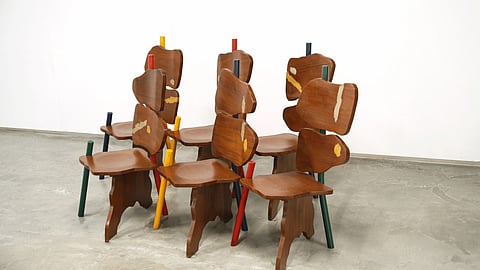
Artist and curator Bose Krishnamachari, also one of the founders of the Kochi-Muziris Biennale, has picked from across categories. In the category of what he calls the master’s blue-chip investment, he suggests the Tyeb Mehta collection showcased at the artist’s centenary year at Art Mumbai, and MF Husain’s painted Furniture Series at Crayon. It’s unique and a highly collectable crossover between sculpture, design, and painting. “Makes for an excellent, long-term conceptual/collectible asset,” says Bose. The painted furniture series at Crayon is a unique and highly collectable crossover between sculpture, design, and painting. He also suggests the Raja Ravi Varma works from the Akar Prakar art gallery.
Bose also recommends Shilpa Gupta’s fan installation and Indian maps drawn on books. “Conceptually, it is one of the most important works in the Indian contemporary scene. For a collector of an institution with philosophical and ideological sensitivity, this is a must-consider acquisition,” he adds.
Hotelier Namita Saraf has been commissioning contemporary artworks, mostly site-specific, for her hotels, including the Hyatt in Mumbai and the Andaz in Delhi, since the 2000s. Her one pick is Gallery Experimenter, known for showing a diverse range of contemporary works with varied and unique narratives. “I don’t shop for art. It’s not a product of investment for me, really,” says Saraf. “For me, I need to connect with the work, feel it, get into a relationship with it, and then live with it,” she adds. So, her advice to young collectors is to invest in younger, newer artists rather than the known, big names such as MF Husain, Paresh Maity, Thotta Vaikuntham, or others in the same league. Her advice to young collectors is to acquire ten works in, say, a crore instead of buying one work for that amount. “The possibility is that four or five of these artists’ works will appreciate in value after a few years,” she says. But if you are into it purely for investment purposes, buy the predictable names. It can’t be denied that the moderns appreciate a lot more and faster than their contemporaries. “The appreciation could even be ten times in three to five years. But it could also not, and then you might be stuck with an expensive work, which you don’t really like or connect with.”
Artist Brinda Miller, too, is of the opinion that investing in younger artists is a better idea. “It’s important to push them and promote them,” she says. Her picks from Art Mumbai are the textile work by Manish Nai at the Apparao Art Gallery, an installation of Dhruvi Acharya at the Chemould Prescott Roa,d and Ritika Merchant’s paper work at Tarq. “These contemporary artists are very talented and already in demand. It would be a good time to invest in their works now,” says Miller.