
Subscribe
Subscribe
- Motoring
- Style
- Home & Design
- Travel
- Food & Drink
- Specials
- News & Tech
- Videos
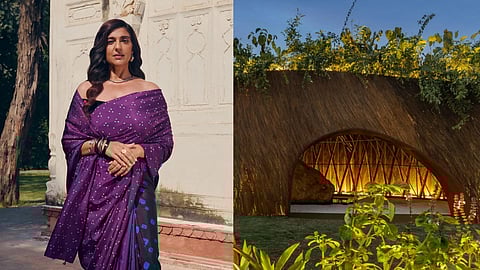
Set within the open expanse of Delhi’s Sunder Nursery, the Aranyani Pavilion unfolds less as a structure and more as an experience, one that mirrors the philosophy of its founder, Tara Lal. Conceived as a space for reflection, gathering, and ecological awareness, the pavilion is the result of Lal’s collaboration with T_M.space, the architecture practice led by Mario Serrano and Tanil Raif. Rather than approaching the architects with fixed plans or materials, Lal brought a vision rooted in Aranyani’s core values: care for land, respect for local ecologies, and a deeper, more conscious relationship with nature.
The resulting spiral-shaped walkthrough installation is constructed from bamboo and upcycled invasive lantana, rising into a living canopy of native plants. Drawing from recurring patterns found across cultures and natural landscapes, the spiral invites visitors to wander, slow down, and arrive gradually, eschewing spectacle in favour of mindfulness.
Robb Report India speaks with Tara Lal on what led to the Aranyani Pavilion, it being her first architectural public work, and more.

Tara Lal (TL): My approach is shaped by systems that have endured precisely because they moved slowly, and sacred groves are one of the clearest examples. They survived across centuries through collective care, rather than through enforcement or expansion. That way of working continues to guide me, reminding me that longevity comes from relationships, not acceleration.
In our conservation practice and projects led under Aranyani Earth, sustaining this pace means committing to places and people for the long term. Community-led conservation only works when trust is built over time and when local knowledge is treated as expertise rather than a supplement. Ours is a more feminine approach to ecology. Scale is not the starting point, and it becomes possible only once a system is stable and supported by those who live with it every day.
The Pavilion follows the same philosophy. After its time in Delhi, it will be reassembled at the Rajkumari Ratnavati Girls’ School in Jaisalmer, where it will become an ecological training centre for young students and researchers. This continuation matters to me, reflecting a belief that ecological work should circulate, teach, and remain useful, rather than peak and disappear.
TL: Ecology is not a specialised subject that belongs behind walls. It is something people live with every day, whether they acknowledge it or not. I wanted the Pavilion to be encountered as part of ordinary urban life, in this case, in the midst of Sunder Nursery, a 400-year-old Mughal-era garden in the heart of New Delhi. We worked closely with architects Tanil Raif and Mario Serrano Puche of T__M.space to conceptualise and design a structure that could be experienced through movement and material rather than explanation. They understood the intent early on and helped translate that vision into a spatial language that remained open, porous, and intuitive within the landscape.
TL: Lantana is an invasive plant. It arrived in India from Latin America through colonial trade, first via the Portuguese and later the British, as an ornamental plant. Except, it didn’t stay ornamental: it spread aggressively, destroying a majority of our native forests and affecting livelihoods. By choosing to build with it, we wanted to make that history visible, and also repurpose this material that is otherwise harmful to nature, and turn it into something that can spark repair.
TL: If luxury is understood as time and attention rather than excess, then restoration can be seen as a kind of luxury. It asks for material understanding and responsibility instead of speed or display. The Pavilion reflects this through spaces designed for pause rather than spectacle. At its centre is a shrine, anchored by a monolithic rock. That choice was deliberate. In many sacred groves I’ve visited, small shrines mark a shift in behaviour; they quietly signal when to slow down, lower your voice, and pay attention. It is a place where movement settles, and awareness sharpens. And today, that can feel like a luxury in itself.
TL: I hope Aranyani, through our projects, our storytelling, and the Pavilion, keeps creating space for a deeper, more felt connection with nature within public life. Ecology often enters the conversation through urgency or crisis. But care is something else: it’s sustained through everyday practice. We’re only getting started. Over time, I hope Aranyani gathers a community of like-minded people and leaders across art, architecture, design, science, industry, history, and education, so we can shape a bigger conversation that comes from here, from this region, in our own language and lived realities.