
Subscribe
Subscribe
- Motoring
- Style
- Home & Design
- Travel
- Food & Drink
- Specials
- News & Tech
- Videos
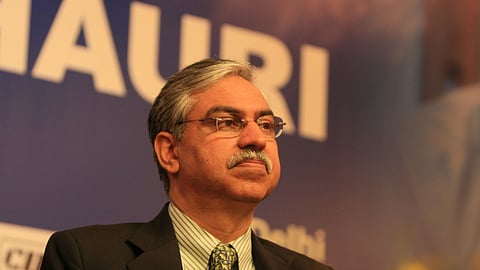
Sunil Kant Munjal has spent decades shaping India’s entrepreneurial landscape, yet some of his most enduring ideas have emerged not in boardrooms but around a dining table. As chairman of Hero Enterprise and founder patron of the Serendipity Arts Festival—now marking its tenth year—Munjal has long believed in the power of conversation, culture, and continuity. That belief also underpins Table for Four, a recently published book born out of a 15-year ritual of long lunches with three close friends. Robb Report India speaks with Munjal on his latest book, Hero, and more.
SKM: It really didn’t start with any grand plan. It was simply four friends getting together. One of us was going through a personal issue, and we thought it would be good to meet and offer some moral support. But what happened was that the conversation was so interesting and engaging because we took time out of our otherwise hectic schedules. There were no constraints—no agenda, no rush. Just the luxury of conversation. And once we experienced that, we said, let’s do it again. And then again. Over time, we became a bit more deliberate. All of us are food lovers in our own way, but one among us—Deepak Nirula—was a true connoisseur. Deepak, who we sadly lost, was one of the most influential figures in shaping how India eats. Nirula’s was the country’s first true QSR (quick service restaurant). He brought consistency, governance, and quality to food in a way India hadn’t seen before. With him at the table, the lunches evolved. We began rating dishes, then service, then ambience. Eventually, we even started evaluating the restrooms—because the condition of a toilet tells you a lot about a place and the people running it. Hygiene, attention to detail—everything matters. We also made a rule not to repeat restaurants. That forced us to explore widely. We just had our 75th lunch a couple of days ago, here in Goa. None of this was planned—but over time it became something quite special, and eventually led to the book.

SKM: Each generation reflects its environment. The first generation post-Independence—especially in North India—was extraordinary. Many were migrants, refugees. When you’ve lost everything overnight, you work harder. You build with urgency and resilience. The second generation—people like us—expanded those foundations, globalised businesses, brought in technology, design, scale. The real challenge often comes in the third generation. Statistically, 94 percent of family businesses don’t survive beyond it. When children grow up in wealth, the ecosystem changes—values shift toward consumption, branding, lifestyle.
That’s why upbringing becomes so critical. In our families, we have consciously tried to raise our children with the same values we were brought up with—to not lose the common touch, to remain compassionate toward those less fortunate, to stay inquisitive, to keep learning and experimenting. We actively encourage experimentation in our enterprises, fully aware that not everything will work. What genuinely excites me today is what I’m seeing among younger entrepreneurs. Their ability to think laterally, to think globally, is remarkable. Entrepreneurship has become part reality, part necessity, and yes, part fashion—but India needs it. What’s most heartening is that entrepreneurs are now emerging from places we would never have imagined earlier: small towns, tier-3, tier-4, and even villages. And they’re building things that would have been unimaginable even 10 or 15 years ago. We have a thriving entrepreneurial ecosystem today. I’m a great optimist about the future.
SKM: Risk-taking, for us, has really become part of our DNA. It’s something we have consciously benefited from. And not everything we’ve done has worked. But despite that, we’ve always said one thing to ourselves—keep experimenting because mistakes are actually the biggest teachers.
One of the earliest uncomfortable risks we took was diversifying out of our core bicycle business into textiles. We set up a multi-fibre spinning mill, and I was involved from the very early stage. It was our first real diversification, the first time we listed a company and took institutional loans—and it was a phenomenal learning experience. But it was also an industry that exposed us to practices we weren’t comfortable with. Over time, we learned a critical lesson: if your values don’t align with how an ecosystem operates, you will always be at a disadvantage.
Another lesson from that period was the importance of openness within an organisation. We consciously encouraged communication across hierarchies. You never know where a good idea will come from—anyone, anytime, any position can offer something valuable. We also learned how to deal with failure. This mindset—experimentation, learning from failure, and staying open—has been essential to every reinvention we’ve made. It’s uncomfortable, but non-negotiable for growth.
SM: Arts remind us that life isn’t singular in focus. They help us appreciate relationships, nuance, and softness.
I began collecting art young. At home, we had artists like Ravi Shankar, Alla Rakha, and Jagjit Singh performing in our living room. These influences accumulate quietly over time. In 1999, I set up a performing arts foundation in Ludhiana. In 2014, the Serendipity Arts Foundation. In 2016, the festival began. The goal was scale, learning, and continuous evolution.
SM: I think we have to recognise that we have one of the richest cultural heritages in the world, but sadly, over the last 500 years or so, it has either been discouraged or allowed to decline. A large part of it has been lost. It is important and critical that all of us not only learn to appreciate and engage with it, but also support the revival and contemporisation of the arts. Art cannot exist only as our past; it has to be our future as well. Therefore, engaging with the arts, making them more meaningful, and contemporising them for the future is just as important as appreciating them.