Subscribe
Subscribe
- Motoring
- Style
- Home & Design
- Travel
- Food & Drink
- Specials
- News & Tech
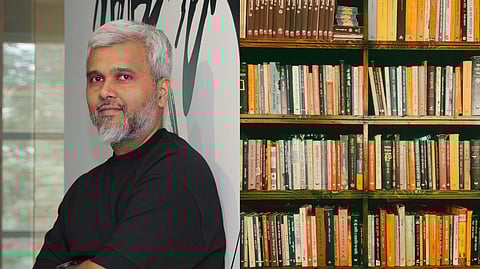
Bangalore-based artist Nikheel Aphale has spent years pushing Devanagari beyond the expected territories of handwriting, signage, and traditional calligraphy, and towards a more contemporary visual language.
His work now sits in spaces as varied as India’s new Parliament Building and The Leela’s 40th anniversary identity, which is perhaps another way of saying that Aphale has found a way to make script travel — across art, design, branding, and culture — without losing its rootedness.
In this conversation with Robb Report India, he reflects on Devanagari as muse, the tactile power of the handmade, and why script-based art feels newly urgent now.
Nikheel Aphale (NA): I was introduced to calligraphy and typography in art school, where we learned about different styles and tools, including Devanagari script. I was intrigued by the idea that letters have a tremendous ability to communicate emotions without relying on graphics or illustrations. They can become visuals in themselves. This aspect fascinated me, and I started exploring forms of the letters as a way to tell stories.
Looking back, my love for alphabets began at home. I inherited a gift for beautiful handwriting from my mother, who has the neatest hand I know. Because of my flair for handwriting, my teachers often asked me to write suvichar (quotes) on the school blackboards. Alongside this, the title lettering of Marathi plays and Hindi films, along with hand-painted signboards, further sparked my early interest.
NA: It is an amalgamation of all these aspects. Being a script of my mother tongue, I was connected with its sound and shape since birth. We share a special bond. It is an integral part of my cultural identity and a core element in my art practice.
NA: At early stages of my calligraphy practice, I realised there is already an immense amount of exposure and appreciation for West and East Asian scripts, but the presence of Devanagari (rather, all Indian scripts) is negligible in the world of visual art. This has driven me to explore Devanagari as an art form, aiming to highlight its global potential. It fuelled my dedication to crafting a visual language that bridges both its traditional roots and contemporary relevance.
NA: Anything handmade holds a special appeal for me. As a calligraphy artist where hand is a crucial factor in my practice, handmade work matters to me because it shows the existence of a human behind it. In calligraphy, every stroke is a direct trace of the moment in which it is made. It’s a reflection of the artist’s state of mind, the rhythm of his breath, the pressure of his hand. These variations, imperfections, and hesitations are not flaws; they are evidence of life. They bring warmth, vulnerability, and authenticity to the work. Digital or AI-generated tools may replicate the work, but without the soul.

NA: It is both exciting and challenging for me as an artist to bring this beautiful art into some functional context with a set brief. I enjoy walking on the fine line between personal and commercial space. The starting point is always to understand the ethos, history, and intent of the brand. That becomes the framework within which I respond, where letters must evoke and convey the personality of a brand.
For the 40th anniversary logo for The Leela Hotels, I aligned closely with the brand’s philosophy. I aimed to reflect a feel of sophistication, legacy, and luxury through the quality of the strokes and overall composition. Similarly, for the Indian Parliament’s Shilp Gallery, I created an artwork on the given theme of Gyan as a part of an installation based on Indian scripts. I used a Sanskrit subhashita to convey the meaning in a contemporary style.
NA: I am optimistic about the future of calligraphy as audiences are becoming more aware and engaged with the art and their mother-scripts. There are now several platforms where people can learn, explore, and experience it. I also see a growing number of artists incorporating their native languages and scripts into their practice. Using vernacular text becomes a reflection of their identity and roots, making the work more authentic and personal. I believe that in the coming years, text/script-based art will emerge as a strong and independent discipline, much like textiles, ceramics, or performance art.
NA: I am optimistic about the future of calligraphy as audiences are becoming more aware and engaged with the art and their manuscripts. There are now several platforms where people can learn, explore, and experience it. I also see a growing number of artists incorporating their native languages and scripts into their practice. Using vernacular text becomes a reflection of their identity and roots, making the work more authentic and personal. I believe that in the coming years, text or script-based art will emerge as a strong and independent discipline.