
Subscribe
Subscribe
- Motoring
- Style
- Home & Design
- Travel
- Food & Drink
- Specials
- News & Tech
- Videos
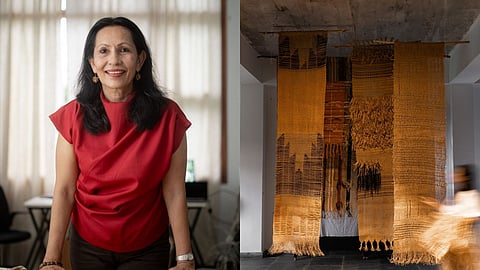
For over three decades, Jesmina Zeliang has been building a vocabulary of luxury from the hills of Nagaland, long before the rest of the industry caught up to the language of artisanal value, sustainability, or indigenous design. Through Heirloom Naga and Cane Concept, the designer and entrepreneur has transformed traditional loin-loom weaving into a globally relevant design practice, working across textiles, collectable craft, interiors, and material innovation while simultaneously creating sustained livelihoods for hundreds of women artisans across the northeast.
What makes Zeliang’s journey remarkable is not merely its longevity, but the timing. She began in the early ’90s, at a moment when Nagaland was rarely spoken about outside the context of insurgency and political unrest. The language of Indian luxury was still largely centred around royal textiles, established craft clusters, and metropolitan design hubs. The northeast, despite possessing one of the richest textile traditions in the country, remained largely peripheral to national conversations around fashion, craft, and commerce.
Yet, from Dimapur, working initially with a single weaver in her backyard, Zeliang began imagining a different possibility—one where Naga textiles could move beyond anthropology and enter the realm of contemporary global design.

Over the years, that leap of faith evolved into one of the country’s most influential craft enterprises. Through Heirloom Naga’s textiles and Cane Concept’s material-driven furniture and craft interventions, she has collaborated with global luxury brands, supplied handwoven and handcrafted products to international markets, and become a cultural touchpoint for travellers, designers, and collectors interested in the future of indigenous craft. More recently, the brands’ work has found resonance within collectable design circles as well, including showcases linked to Milan Design Week and Homo Faber.
In conversation with Robb Report India, she reflects on building a craft business from the margins, why “market intelligence” matters as much as design, the contradictions of artisanal luxury, and why the human hand may become even more valuable in the age of AI.
Jesmina Zeliang (JZ): When I started out in the early ’90s, Nagaland was going through a very difficult phase, and there was little positive visibility associated with the state. But even then, I felt our greatest strength lay in women and weaving. My earliest memory of craft comes from my mother, who used to weave our school bags and shawls for my father every year. I didn’t inherit her weaving skills, but I think I inherited an appreciation for handmade textiles and the dignity attached to them.
Later, after I got married very young, I found myself wanting to do something meaningful. Around the same time, I was invited to participate in the second edition of the Surajkund International Crafts Mela. I worked with a single weaver to reinterpret traditional Naga textiles into contemporary products, and the capsule collection sold out within two days. Looking back, I think people responded to the novelty of seeing Naga textiles presented in a different, more contemporary design language.
JZ: For indigenous communities, sustainability was never a concept or a marketing strategy—it was simply a way of life. The loin loom, which forms the basis of Naga weaving traditions, is among the oldest forms of weaving in the world. A weaver owns her loom, works within her own environment, and creates with almost no waste. So when people today speak about “zero-waste luxury,” I often feel we have been living that reality for generations.
At the same time, sustainability must also mean sustainable livelihoods. I dislike the phrase “fair wages.” Why should artisans merely be paid fairly? They should be paid handsomely. If we genuinely want craft traditions to survive, then artisans must be able to live with dignity and aspiration. Otherwise, the younger generation will naturally move elsewhere.
JZ: Because visibility matters. We have worked with some of the finest international names over the years, but often we are not even allowed to publicly show the work we have produced. I understand that luxury brands need to protect their design language, but when indigenous communities become completely invisible within the supply chain, it becomes problematic.
There is also a contradiction within the luxury system. Brands love to romanticise artisanal work, but at the same time, they often impose factory-level expectations on handmade production. We have had compliance inspectors checking handmade cushions as though they were industrial products. Luxury cannot celebrate the romance of craft while refusing to accommodate the realities of handmade work.
JZ: The northeast holds an extraordinary concentration of weavers and indigenous craft traditions, yet the region remains peripheral in larger market and policy conversations. People often speak about craft here only through the lens of heritage or nostalgia, but I believe we need to start looking at it as part of the creative economy.
Craft creates jobs, entrepreneurship, ancillary industries, and entire ecosystems of livelihoods. In many ways, I believe craft is India’s oldest startup. Particularly today, in the age of AI and automation, the value of the handmade becomes even more important because what we create with our hands remains deeply human.
JZ: Restlessness, honestly. I still wake up thinking about what comes next—for the artisans, for the region, and for the craft itself. I worry about whether younger generations will continue weaving 20 years from now, especially as many weavers’ children move into other professions and global industries.
At the same time, I feel hopeful. When younger people visit the Heirloom Naga centre today, when international designers collaborate with our artisans, or when handmade work is valued not as charity but as excellence, I feel the narrative is slowly changing.