
Subscribe
Subscribe
- Motoring
- Style
- Home & Design
- Travel
- Food & Drink
- Specials
- News & Tech
- Videos
AI generated summary, newsroom reviewed
Exhilaration is the word that comes closest to describing what you feel as you move through an exhibition that brings over 300 works by Matisse under one roof.
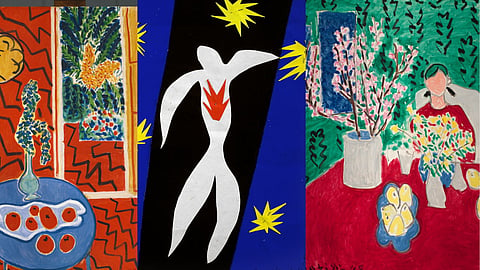
Matisse, 1941–1954, an exhibition organised by the Centre Pompidou and the Grand Palais in Paris, documents the artist’s final creative phase, a marked departure from his previous work, with several works rarely seen in France.
In 1941, after a serious operation that nearly cost him his life, Matisse felt he was entering what he called his “second life.” It would become perhaps the most prolific period of his career, a season of renewed creative vigour in which he gave himself wholly to evolving techniques for artistic expression.
It is a riot of colour, and something rapturous takes over as you encounter his still lifes, which are still, and yet not. The green vase, the luscious magnolia (Still Life with Magnolia), his red tulips, scattered lemons (Tulips and Oysters on Black Background), everything tilting, jostling, defying spatial logic. He gifted the latter to Picasso, in a relationship shaped by mutual respect and a lifetime of rivalry.
You’re reminded early on in this exhibition of epic proportions that Matisse did not paint things as much as the relationship between them.
The forties, with war consuming France and much of Europe, affected Matisse personally too. In 1944, his wife and daughter, who had joined the Resistance without his knowing, were arrested by the Gestapo. Amélie was imprisoned, Marguerite was tortured, and deported before being freed several months later.

Considered a degenerate artist by the Nazi regime, he became the hero of the nationalist movement unwittingly because he turned down invitations to safety from his art dealer son in the US and continued to stay on in France. Matisse rejected the nationalist propaganda that tried to co-opt him as a “jewel” of the French art school and engrossed himself in his work. He refused, however, to show his work during this period.
Still, The Romanian Blouse (1940), in which the colours of the blouse worn by the Romanian woman are inspired by the French flag, indicated a sense of optimism in those early days of war.
The five interiors, including Young Girl in White Dress and Young Girl in Pink in an Interior, are like standing in front of a dessert trolley with your favourite cupcakes. You dart back and forth between them, admiring them, unable to decide which one you want to spend the most time with.
These canvases, bright with creative effervescence, are surprisingly joyful, given the fraught times in which they were painted. Rooms bathed in light from the window, solitary women conveying emotion with featureless faces on striped chairs, sunlight forming long ochre strips on the floor and walls, his thriving garden outside the window: this vivid chaos, this dizzying beauty alive with colour, becomes overwhelming one painting after another.
Matisse left the faces empty intentionally, allowing viewers to ascribe their own feelings to them. Nothing was random about his work. You’re reminded through the wall texts that it took great mastery, time and effort to produce what feels inevitable.
There are his charcoals, made meticulously in one sitting, and his “decorated books,” in which image and text vie for your attention.
In Asia, in a painting he called the “lightness and joy of spring,” a woman of mixed race poses against an opulent decorative backdrop, dressed in purple and blue, playing with the glassy beads of her necklace.
In another dark room, a rotunda, a series of circus-themed prints in intense pinks, greens, and blues forms a display made from paper cut-outs painted with gouache. Matisse had been asked to make a book about colour. These maquettes, which include the famous black Icarus falling past yellow stars, were created for the book that would become Jazz.
Following an air raid on Nice, Matisse moved to Vence. His journey was only going to get more exciting as he tried to overcome the challenges of his confinement to a wheelchair and his unsteady hand by replacing the paintbrush with scissors, even though he didn’t entirely give up painting. At nearly 80, Matisse began to work with gouache cut-outs that may have appeared almost childishly simple at first glance, but they gave him a new language of articulation, with a freedom no other medium might have allowed before.
The final passage of the exhibition belongs to the cut-outs and to Matisse’s acrobats in blue. They twist and spring across the paper, all limb and youthful athleticism and impossible balance. You have to remind yourself that these were made by a man in a wheelchair, cutting into painted paper because the body had begun to refuse him old permissions.
For me, the greatest message was that what looks easy almost never is. Matisse’s simplicity was not casual. It was worked on, revised, arranged, and practiced.
The other lesson you walk away with is that you’re never too old to become the best you’ve ever been.
“I hope, however old we live to be, we die young,” Matisse said in 1950. It could stand as the theme for this exhibition.
Exhibition ends July 26, 2026