
Subscribe
Subscribe
- Motoring
- Style
- Home & Design
- Travel
- Food & Drink
- Specials
- News & Tech
Before he became one of India's most distinctive creative voices, Vikram Goyal was sitting at a desk at Morgan Stanley, first in New York, then Hong Kong, doing what one does in finance. Numbers, markets, the ordered logic of capital. It is not an obvious prelude to a life spent coaxing brass into extraordinary form. And yet, in retrospect, the distance between those two worlds is precisely what gave his practice its particular clarity of purpose.
In 2000, Goyal returned to India. He co-founded Kama Ayurveda, a skincare and wellness brand that went on to earn considerable recognition.
Working primarily in brass, the ancient metal, he has spent the better part of two decades building an eponymous studio and lifestyle brand, Viya, that encompasses large-scale wall panels, architectural screens, chandeliers, consoles, and immersive installations. The techniques he employs are traditional ones: repoussé, hand-hammering, methods passed between generations of master artisans. Not surprisingly, the results are anything but archaic.
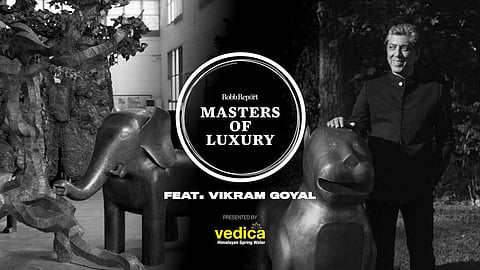
Every piece in his studio is handcrafted on-site and in close and evolving dialogue with the craftsmen he works alongside. He was also the curator of The Great Elephant Migration, an international travelling exhibition of one hundred elephant sculptures that became, in its own right, a statement about the power of Indian cultural storytelling at scale.
Robb Report India sat down with him to talk about brass, memory, and what it takes to reframe a country's creative inheritance for the world.
Vikram Goyal: I'm neither an artisan nor a trained designer, and we operate out of the workshop model or the karkhana model. We have a team of artisans, designers, production engineers — there’s a whole bunch of people working together. Every time there’s an idea, we begin with some initial sketches, and in our workshop, we make maquettes or samples. We go through endless rounds of sampling before we find something ready to move forward. Only then do we formalise the drawings and proceed with the final execution.
Vikram Goyal: All designs come from us. Customisation only happens if someone wants to change the size or the use of an object. For instance, if we’ve created something as a screen and someone wants it adapted into a wall panel, then we customise it. But all the ideation and product development happen within the studio.
Vikram Goyal: I’ve had a whole range of inspirations — from chinoiserie to nature to abstract forms. There’s been a wide spectrum of references that I’ve drawn upon to feed into our work.
Vikram Goyal: The most challenging work to date has been Soul Garden, a project I did last summer, which we showed at Design Miami/Paris in the gardens of Karl Lagerfeld’s old house. It was an installation where we drew upon India’s vast reservoir of culture and literature, particularly the idea of animals as revered spiritual beings.
We explored the Indian philosophical belief that animals are sacred and integral to fables such as the Panchatantra, where they exist as characters carrying moral and spiritual wisdom. We created a series of animals — the elephant, the tortoise, the tiger, the crocodile, or makara — each with its own significance in Indian cultural history.
Each object contained a secret compartment where the Panchatantra fable was illustrated in the Arapuze language. We also collaborated with a smell scientist who infused the environment with scents associated with the making of the animals — the smell of burning metal, the habitat of the animals, and so on.
The idea was to create a collaboration where the world could experience these animals not merely as sculptures, but as carriers of ancient wisdom — a cross-section between nature, craft, and spirituality.
This work took me completely out of my comfort zone. It was the first time I had worked with animals, and it was incredibly challenging, but I’m very happy with the outcome.
Vikram Goyal: I’ve always been interested in the visual cultures of India. I studied engineering and economics, and worked with Morgan Stanley in New York. I then returned to India and co-founded Kama Ayurveda with the idea of taking the essence of Ayurveda into the contemporary world.
Eventually, I began working with craft and design. Today, we have Vikram Goyal Studio, which focuses primarily on metalwork, and we recently launched Viya, a lifestyle brand where we are working with a variety of artisanal crafts.
Vikram Goyal: Viya is a lifestyle brand rooted in three key pillars. First, everything is made in India, handmade in India, and artisanal. Second, every product has an Indian story to tell — whether it’s a myth, a fable, a monument, a colour, a bird, or an animal. Third, the design is India-agnostic. We didn’t want it to feel ethnic. We wanted a modern lifestyle brand rooted in India.
The collection spans home décor, accessories, soft furnishings, carpets, and now apparel. I wanted to take design beyond the collectible design space we had established with the studio and make craft and design more accessible. That’s why we launched Viya.
As for Trafford House, I genuinely couldn’t have found a better setting. It’s an old heritage building that beautifully complements our collection — contemporary in design, but deeply rooted in craft and storytelling.
Vikram Goyal: When I began, I knew I wanted to work with craft in India. I had a list of six master craftsmen who had worked with the Festival of India. I met puppeteers, embroidery artisans, and eventually stumbled upon Rameshji, who worked with metal in his garage.
I immediately fell in love with brass because I could see its phenomenal sculptural possibilities. I liked its colour, its sheen, and over time, I realised just how versatile it is as a material. You can create extraordinary three-dimensional objects with brass in ways that are difficult with other metals.
Sometimes you just instinctively know when something works for you, and that happened with brass.
Vikram Goyal: Absolutely. My maternal family is from Rajasthan, and although I grew up in Delhi, I spent much of my childhood travelling through Rajasthan.
Both Delhi and Rajasthan have this extraordinary sense of grandeur — palaces, forts, paintings, sculpture, Mughal influence — and all of that deeply shaped my perception of art. I naturally gravitate towards larger-than-life scales and statement-making pieces. Scale is very important to me, even though the works can exist beautifully within minimalist environments.
Growing up amidst the visual richness of Rajasthan and Delhi definitely shaped what I consider relevant to my work.
Vikram Goyal: One of the biggest interventions we’ve made — and one I’ve enjoyed immensely — is in the world of repoussé. Traditionally, repoussé was used primarily as surface decoration. Many of the artisans practising it moved from Banaras to Delhi.
Our studio has a dedicated arm focusing solely on repoussé, where I’ve been able to reinterpret visual cultures ranging from chinoiserie and Indian miniature paintings to pichwai and abstract art.
The beauty of repoussé lies in the process itself. You chisel into sheets of metal from the reverse side while the sheet rests on a bed of wax. It requires extraordinary artistic and material intelligence. What makes it fascinating is that you only truly discover the final result six to eight weeks later, when you lift the sheet and see what has emerged.
That unpredictability makes it incredibly rewarding.
Vikram Goyal: Yes. All of our craftspeople are from North India, where there’s a strong history of sheet metal work. Most metal studios around the world work with cast metal — sand casting or wax casting — whereas we work with sheet metal. The expertise for that has traditionally existed around Banaras and North India.
Vikram Goyal: It’s extremely important for me to present my work on global platforms alongside the world’s best. We’ve been fortunate to collaborate with Niloufar Gallery in Milan and showcase at Milan Design Week, PAD London, Design Miami/Paris, and other international forums.
For me, it’s about showcasing the best of India alongside the best design from around the world.
Vikram Goyal: Indian design is still nascent, though it’s gaining tremendous traction. One area where we could accelerate growth is through stronger representation. We need more design galleries, much like the ecosystem that exists for art galleries.
Design galleries can help guide designers and also serve as a corridor between designers and clients.
Vikram Goyal: I’ve been deeply inspired by the animaliers of the early 20th century — François-Xavier Lalanne, Bugatti — as well as Paul Evans and his brutalist works. His practice has greatly influenced my own brutalist direction.
Then there are the mid-century masters such as Gio Ponti, Carlo Scarpa, and Frank Lloyd Wright. There are many influences.
Vikram Goyal: Animals are incredibly difficult to execute in sculpture — in brass, or in any medium really. That’s probably why you don’t see too many designers working with animal forms.
India has such a rich tradition of animal sculpture, and I’ve always been fascinated by it. I’ve also been obsessed with elephants since childhood. I’m a patron of the Elephant Family and have worked on several craft-oriented projects for them.
At some point, I simply felt it was time to begin something completely fresh and different, and animals became that direction.
Vikram Goyal: Right now, I’m spending most of my time on Viya. We’ve expanded from hard goods to soft goods, carpets, and apparel. In India, the possibilities are endless because there are so many crafts to work with, so we’re constantly exploring what comes next.
Vikram Goyal: I recently published a book titled The Shringara of Srinathji, based on my family’s collection of Srinathji miniature paintings. The Nathdwara temple in Udaipur houses the Srinathji deity, and my mother’s ancestors were great patrons of the temple. In gratitude, they were gifted this collection of miniature paintings.
Most people are familiar with pichwais, but these are actual paintings.
Vikram Goyal: Luxury is the ability to change people’s lives — to have the financial and creative resources to inspire people, provide meaningful employment, revive traditions, and create objects that bring people joy.
Beyond joy, I think it’s about instilling pride — pride in who we are, what the country represents, and what our heritage stands for. That is deeply inspiring to me, and I feel fortunate to be able to contribute in that way.
Vikram Goyal: Good sleep.
