
Subscribe
Subscribe
- Motoring
- Style
- Home & Design
- Travel
- Food & Drink
- Specials
- News & Tech
- Videos
AI generated summary, newsroom reviewed
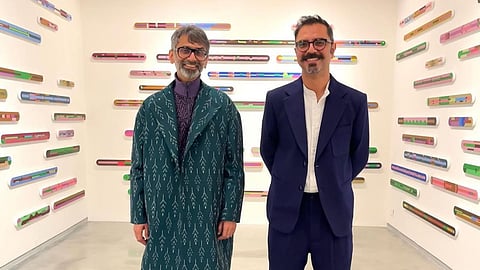
The dynamic duo of Jiten Thukral and Sumir Tagra simply cannot be placed within a single heteronormative field such as painting, sculpture, installation, video, performance, or design since they work at several unique intersections of all of these. As such, the duo has gained immense critical popularity over time and enjoys a spot of far-reaching renown within the art discourse of India and beyond.
While Thukral was born in Jalandhar in 1976, Tagra is a thoroughly Delhi boy, born in the capital in 1979. Both trained on separate paths until they met. Thukral received his BFA from Government College of Arts, Chandigarh in 1998 and his MFA in 2000 at College of Art, Delhi; Tagra finished his BFA in 2002 from College of Art, Delhi, and later pursued his post-graduate degree at National Institute of Design, Ahmedabad. It was only later that the two young individuals formed alliances, each bringing his own expertise to the table.
In a couple of decades, their work travelled to major platforms internationally, including the Asia Pacific Triennial, the Centre Georges Pompidou in Paris, the Arken Museum in Denmark, Kunstmuseum Bochum, the Lyon Museum of Contemporary Art, and Tokyo's Mori Art Museum. Within India, their 2015 solo show Games People Play at Mumbai's Dr Bhau Daji Lad Museum continues to remain one of the defining chapters in their career. Their work often tackles everything from Punjab's migration culture to ecology and collective memory.
This month, Thukral and Tagra are part of Robb Report Art Circle, which allowed us to sit with them one evening and chat about everything ranging from their artistic inspirations to Indian art, best galleries, and more. Parts of the long and wonderful conversation are produced here as an interview.
Thukral and Tagra (T&T): I think we see ourselves as global citizens as much as Indian ones. We live somewhere where the food, weather, and everyday life are extremely local and specific — that gives us a lot to reflect on. But there's also a larger international language we're part of. This shifts from project to project. For example, a project centered on farming was deeply rooted in local, rural Indian life, but the audience engaging with it isn't necessarily the farmer — it's often a more knowledgeable, international audience that could be anywhere. So our approach involves going into rural contexts to understand what something really means, while using design-research methodologies — since we come from a design background — and the final outcome might be an exhibition, a publication, or even a game design.
T&T: In the twenty-plus years we've been active, this visibility has steadily increased, though it moves in waves. Artistic practices here are as valuable as anywhere else in the world, but there are also economic factors — India is seen as a market with potential. Still, artistic practices carry their own voice globally, and collectively they build a broader understanding of what the region represents.
T&T: It was always part of the global discourse — it's just that the vantage point has historically been in the West, which is where recognition and value have tended to concentrate. But artistic practices here run much deeper than that, and they're solid enough to stay. Looking ahead, we hope to see more patrons and institutions emerge from within India itself, since patrons, institutions, and museums are what really support and grow the ecosystem.
T&T: For us, it's always been about generating and sharing knowledge and wisdom — through conversation, through exhibitions, through how we construct the narration of a show. Working together as a duo on a painting means a great deal to us — it's a safe space to create and to look after our families and the people who work with us. That's central to who we are, and something we don't want to lose. What we really want people to understand is that this work is a long, meditative practice — not about a single exhibition or piece, but a larger, ongoing dedication to building a body of work that keeps evolving and responding to the present moment.
After a long and thought-provoking conversation, the duo graciously shared five figures whose work has profoundly shaped their own creative practice. Spanning art, architecture and fashion, these are the visionaries they return to for inspiration.
Theaster Gates – An American artist whose multidisciplinary practice explores race, history, urban renewal and social engagement through sculpture, installation and performance.
Olafur Eliasson – The Danish-Icelandic artist renowned for immersive installations that combine light, colour and natural phenomena to transform the viewer's perception of space.
Robert Gober – An American sculptor best known for his psychologically charged works that examine themes of identity, domesticity, memory and the human body.
Hussein Chalayan – The British-Cypriot fashion designer celebrated for his conceptual approach to clothing, where technology, architecture and storytelling intersect.
Zaha Hadid – The late Iraqi-British architect whose bold, fluid forms and groundbreaking buildings redefined contemporary architecture across the world.
Bijoy Jain – The Indian architect and founder of Studio Mumbai, admired for his deeply contextual, craft-led architecture that seamlessly blends traditional knowledge with contemporary design.
