
Subscribe
Subscribe
- Motoring
- Style
- Home & Design
- Travel
- Food & Drink
- Specials
- News & Tech
- Videos
AI generated summary, newsroom reviewed
From curating life-sized immersive exhibits for Nobel laureates Abhijit Banerjee and Esther Duflo to creating installations for some of India's leading non-profits, Vishal Chand and Abhimanyu Rattan Mehra of The Twin Seduction are on a mission to express the complex realities of distinct demographics and paramount issues through art rather than statistics and data points.
Based in New Delhi and Amritsar, they have curated and designed exhibits and installations across gender empowerment, education, climate change, marginalised women's labour, gender-based violence, among others.

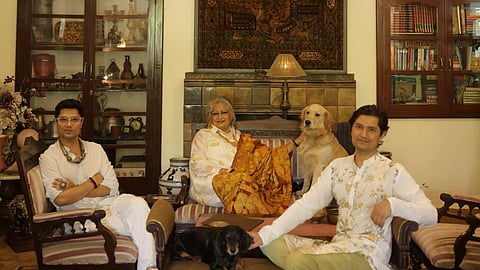
Robb Report India chats with the twin brothers over cups of chai in the courtyard of their ancestral Amritsar home, Ranjit's SVAASA, a historic homestay archived and restored by them, where the conversation unfolds in the company of their furry companions.
Vishal & Abhimanyu: Our very first project addressing social issues began with an association with J-PAL, and that happened almost by coincidence. As designers, we’ve never wanted to be limited by a particular space, event, or theme. When Shobhini Mukerjee, the South Asia head of J-PAL, introduced us to the extensive amount of work they have been doing with children on education, women on livelihood, on the environment with farmers, and many more segments, we found it deeply compelling.
As the stories from the ground were being narrated to us by the team members of J-PAL, we were already visualising ideas.
What struck us most was the shared humanity behind the research. We wanted to present these stories in a way that people in a modern urban setting could immediately connect with. We hadn’t realised the scale of the work happening on the ground. The common thread for us was empathy, and empathy has no borders. Our goal was simply to be authentic through design and do justice to their work.
Vishal & Abhimanyu: We spend a lot of time absorbing and understanding the research, the data, and the statistics before we begin designing. Reports often contain figures and numbers that can feel inaccessible or overwhelming for the general public. Our role is to translate that information into something visually engaging and emotionally relatable without losing its meaning.
Vishal & Abhimanyu: We remember working with a non-profit called SEWA Delhi, a branch of the larger umbrella SEWA Bharat. They work to empower marginalised women labourers who work in the wastelands across New Delhi. One of the key installations at the exhibit was inspired by a photograph of a home, as temporary and gravely humble as it was, which moved us. So we literally mirrored that very make-shift shed and asked for over a 100 pairs of discarded shoes from the wasteland dumps, which they work in to bring forward the reality and disparity of urbanisation.
When the shoes arrived, the smell immediately took over Bikaner House, the exhibition space. The organisers asked whether we planned to do something about the odour, and we explained we did not want to. We didn't want to sanitise or polish or glamourise their reality. It made many visitors twitch, which meant they could feel their agony. At the same time, the women from the community - the rag pickers who were present at their own exhibit felt seen and respected.
Vishal & Abhimanyu: Issues like prostitution, human trafficking, and the pressures of overpopulation require public attention. We'd love to create a large-scale public installation in an open space. Perhaps on a busy street, where people can't simply walk past without confronting these realities. Art has the power to interrupt everyday life, and sometimes that's exactly what's needed to start difficult conversations.
The Twin Seduction is currently designing the office of ChangeInkk, creating child-friendly spaces that raise awareness about specific learning disabilities and dyslexia.