
Subscribe
Subscribe
- Motoring
- Style
- Home & Design
- Travel
- Food & Drink
- Specials
- News & Tech
- Videos
AI generated summary, newsroom reviewed
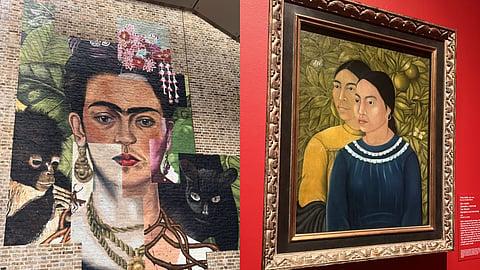
London is in the grip of Fridamania. Stroll down South Bank, and the beige brick walls have been transformed into a colourful screen — murals painted by artists, all under 25, generations removed from Frida Kahlo's lifetime, yet proof of just how enduring her legacy remains. Carnaby Street in Soho, meanwhile, is strung with garlands of traditional papel picado (cut paper), commemorating moments and scenes from Kahlo's life as part of the public installation Frida Icónica by Mexican artist Alejandra Ballesteros — turning into colourful backdrops for the inevitable tourist pictures and reels. But the real deal is the massive retrospective “Frida: The Making of an Icon” at Tate Modern, which has already made history as the largest pre-selling exhibition in the gallery's history.
Making my way into the gallery, with an entire floor dedicated to the artist, it's hard to miss the crowd — spanning all ages and nationalities. A reminder that Frida Kahlo's status as a pop icon, and her brand equity by extension, remains unshakeable 72 years after her death in July 1954. The exhibition traces how Kahlo grew from a relatively unknown Mexican painter into a cultural phenomenon.
It hosts 30 of her original works, alongside Frida as seen through the lens of those she inspired and was, in turn, a muse to — confirming her place as one of the most indomitable figures whose politics and ideology continue to matter, especially in today's polarised times.
Among the first works on view are black-and-white images of an 18-year-old Frida taken by her father — in one, she is in a silk dress; in another, she wears her father's suit and holds a cane, a reflection of the gender fluidity that would go on to find resonance in her work. A pencil drawing on parchment paper, titled The Accident, is one of her earliest — made after the bus accident at age 18 in 1925 that didn't end her ambitions of a career in medicine but left her gravely injured, causing a lifetime of pain and medical complications that compelled her to turn to art instead.

One of her earliest paintings (1926), a self-portrait in oil on canvas, a year after her accident, was a gift for her boyfriend Alejandro Gómez Arias, and shows Frida in a bathrobe with a typically plunging neckline — a clear signal that she saw herself as a modern woman, free of societal constraints. Taking centre stage nearby is Kahlo's painted plaster corset, one of the most poignant objects associated with her lifetime, worn to support her spine after the accident. A hammer and sickle across the chest reflects her communist beliefs, while an inverted foetus over the abdomen speaks to her own experiences with pregnancy, loss, fertility and the female body.
In another, unfinished work, Frida — hair closely cropped, in a modern dress — sits outside a café in Mexico City; behind her hangs a portrait of Pancho Villa, the key figure of the Mexican Revolution, and alongside her are school friends, budding intellectuals all. The painting's fragmented perspective, likely drawing on Cubism, creates an unsettled, restless mood.
From these early experiments to finding her own visual grammar, Frida defied labels — even as her contemporaries and peers kept trying to box her into the frameworks they felt described her best.
André Breton, the French writer and poet known as the Pope of Surrealism, was among them — he claimed her a surrealist, an affinity she herself declined, saying she'd never even heard the word before he used it. He famously described her as “a ribbon tied around a bomb.” This statement perhaps captures that same duality: the softness and the danger, the celebration and the suffering, both coiled into one woman.
However, Kahlo's marriage to Diego Rivera, a man twice her age and one of Mexico's most celebrated artists, was as tumultuous as it was inspiring — her work was starkly different from her famous husbands, though he often appears folded into her self-portraits as a marker of their bond. Diego and I, painted on their anniversary, shows a single head formed from two ghostly, overlapping portraits of Frida and Diego.
On the other side of that story is My Dress Hangs There, which reflects Frida's own disconnect from her husband's fame and their travels — her Tehuana dress suspended between a trophy and a toilet. The painting yet another reminder that Frida lived and breathed for her own country, Mexico.
A series of black-and-white images of a bare-chested Frida, taken in 1938 by Julien Levy — rumoured to have had an affair with her — were never made public in her lifetime. Levy captured a candid Frida in the ritual of styling her hair, which he described as “fantastic liturgy.” The images are raw, sensuous, aesthetic in every sense.
There are images, too, of Frida painting in bed, and of Frida as captured by other artists — known always for her distinct fashion sense: the colourful indigenous Mexican garments, the huipil and long skirts with floral motifs, lace and ribbon panels, embroidery and ruffles.
A trio of her Tehuana outfits, displayed together in glass cases, drives the point home. One is a teal huipil paired with a crimson skirt banded in gold, its hem a cascade of white ruffles. Another, at the centre, is a white huipil striped in red embroidery with a black waistband, the skirt falling into the same soft white ruffle. The third is a coral huipil patterned with a black floral motif, worn with a dark green skirt trimmed in gold. Alongside her clothing sit her three great material passions — her jewellery: chiselled silver, fused-glass earrings, filigree work, polished turquoise rings, as well as a chunky silver choker.
From this self-construction and early experimentation to her commissioned work, one piece stands out — the portrait of Dorothy Hale. Commissioned as a memorial, Frida instead painted the rawness of Hale's death, its sadness, drawing on newspaper reports rather than softening or idealising the moment. It's a work that shows, once again, that Frida, as an artist, refused to be defined by what was expected of her.
An entire section shows how Frida became an indomitable part of pop culture — her floral headdress, unibrow and red lipstick reimagined again and again, from Salma Hayek's face to votive candles, bags, T-shirts, coffee cups and mugs.
Frida: The Making Of An Icon is as much a celebration of a woman who defied every norm as it is an unflinching look at a soul in pain — a life inseparable from its suffering. It’s this duality that lingers as one walks out of Tate Modern into the cool sunshine of London.
The exhibition runs until 3 January 2027.