
Subscribe
Subscribe
- Motoring
- Style
- Home & Design
- Travel
- Food & Drink
- Specials
- News & Tech
- Videos
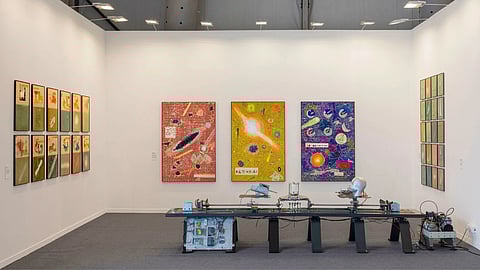
Now in its 17th edition, India Art Fair has evolved beyond the generic booths and displays. This year, it positioned itself as an open cultural terrain. Over the last four days, the fairgrounds at New Delhi’s NSIC, Okhla came to life with sculptures and participatory art works from over 90 galleries in the national capital and beyond.
Central to the 2026 edition of India Art Fair, the Outdoor Art Projects established the fair’s conceptual framework. Upon entering, you stepped into a world distinctly removed from everyday life. Children’s tours curated by Kiran Nadar Museum of Art (KNMA) and multilingual guided walks welcomed audiences of all ages to engage with art, while Know School and the Rediscovery workshops foregrounded ecology, sustainability and living traditions. At the same time, accessibility and inclusivity sat at the heart of the programme. Workshops spanning dream catcher making, sonic art, weaving, pottery and food-led explorations of identity were conducted in English, Hindi and Indian Sign Language, with live translations into Punjabi, Odia and Saura.
With so much for the eye to take in, certain exhibits stood out:
Paresh Maity’s Recycle of Life set the tone early on. Here, charred wood meets recycled metal, drawing together decay and renewal in a work shaped by the artist’s childhood observations of small-town economies of reuse. Nearby, Deepak Kumar’s Breathing Space reframed abandonment through towering sculptures that foreground weed, and similar plants typically dismissed as invasive, as agents of regeneration. Aku Zeliang’s Huh Tu Vessels brought together cane weaving and metalwork in monumental surahi forms, developed in collaboration with artisan communities in Jodhpur.
Emami Art’s Kolkata-rooted showcase displayed traditional practices through natural pigments on handmade paper, layered woodcut prints on acid-free archival sheets, dry pastel and charcoal on rice paper, and cotton-thread embroidery on polythene. In tandem, installation-led narratives deepened the material focus. Vikram Goyal’s work, anchored in cosmos, nature and belief systems, explored frameworks through which humanity has long understood forces beyond its control. Gunjan Gupta’s Held in Place examined India’s relationship with seating, posture and power, echoed by reflections on how the arrival of the chair reshaped social hierarchies.
Ecology and sustainability anchored the fair. The Porgai Artisans Association combined lambadi embroidery, upcycled fabric and zero-waste principles, alongside Sindhu Kamraj’s seasonal study of the Sittilingi Valley. Art Houz embeded real stone using inlay techniques, while KNMA and Grosvenor Gallery explored ecology and collective knowledge. Works by Dumidumi Illangasinghe, MAPIN Foundation, and Serendipity Arts further underlined the fair’s material and conceptual depth.
Similarly, Ayush Kasliwal’s Charpai Project, reimagined through digital interventions by AI artist Goji, became a site for rest, conversation and spontaneous exchange, where the charpai shifts from furniture to social architecture. Questions of the body, vulnerability and time surfaced in Arun B.’s Duration, a 15-foot suspended human figure constructed from wax and mesh, poised mid-air with arms raised in a gesture that recalls both labour and amnesia.
Beyond objects and installations, India Art Fair placed strong emphasis on dialogue, with a Talks Programme that brought together multiple discussions on AI, indigenous knowledge, the art market, public institutions and freedom of expression.

In line with the emphasis on art discussions, Robb Report India, too, organised an intimate, invite-only panel discussion, in collaboration with BMW India, ahead of the fair’s public opening on February 8, 2026. The evening at the BMW Collectors’ Lounge included a moderated panel led by Avarna Jain, chairperson of RPSG Lifestyle Media, bringing together voices from art, design, culinary culture and royalty. The conversation included Chef Manish Mehrotra, Raghavendra Rathore, Sunita Shekhawat, and Yeshwant Holkar, who reflected on how art is lived with, collected and passed on as legacy.
Beyond the discussion, the lounge showcased exclusive, never-before-seen works, including The Holkar Sari, a contemporary interpretation of the garment worn by Maharani Chandravati Bai Sahib; Ottoman-inspired enamel boxes crafted using the champlevé technique; and The Listening Heart, a kinetic artwork by Rathore that made its India debut. Anchoring the space was the BMW Concept Speedtop, unveiled in India for the first time.
Outdoors, at the fair grounds, Judy Chicago’s iconic What If Women Ruled the World? made its India debut as a participatory quilt, while Dumiduni Illangasinghe’s Soft Armours brought broken bangles into dialogue with mushrooms, reimagining vulnerability as resilience.
What emerged, finally, was a fair that called for patience, attentiveness, and dialogue. Art here did not insist on answers; instead, it invited you to stay with it a little longer.