
Subscribe
Subscribe
- Motoring
- Style
- Home & Design
- Travel
- Food & Drink
- Specials
- News & Tech
- Videos
AI generated summary, newsroom reviewed
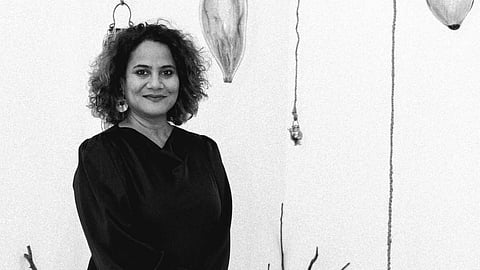
When Gaston Bachelard's book The Poetics of Space came out, ruminations around the world on the notion of 'home' became widespread. What the author succeeded in doing was taking 'home' as a geometric and geographic concept and turning it into a matter of emotion and memory. “For our house is our corner of the world. As has often been said, it is our first universe, a real cosmos in every sense of the word. If we look at it intimately, the humblest dwelling has beauty,” wrote the bearded writer-philosopher. If Monali Meher's work Walking Root Route deals with anything, it's this notion of home and belonging.
At a time when ideas of migration, identity and belonging keep rapidly shifting and dominate public discourse across the world, for Meher, the shift has been less a change than a transformation. "Home is no longer something I think of as a fixed location or a singular point of origin," she says, "instead, it has become a living, expanding network of memories, relationships, histories, and experiences that continue to grow with me." The banyan tree, with its aerial roots that travel before they take hold, became her guiding metaphor. "Every place I have lived and worked leaves a trace, just as every new root strengthens the tree rather than replacing it." Drawing on the ancient banyans of Pune, her birthplace, she began thinking about how cities, like people, carry layers of memory even as they keep changing. A recurring red thread running through her work became her way of visualising that continuity, connecting bodies, landscapes and memories. As she puts it simply: "the home is a home, is a home—the home is where the heart is."
Meher's practice moves dynamically between performance, installation, photography, glass, textiles and drawing, yet she resists the idea that the body has ever left the frame. "The body is always present, but often as something fragmented rather than whole," she explains. Even when it isn't visible, it remains the starting point, leaving its trace in gesture, material and memory. "A line can hold the gesture of a movement; a stitched thread can carry the rhythm of touch; glass can embody both fragility and resilience." She has come to think of the body less as a subject than as a methodology—the way she listens to and connects with place, whether walking through Pune or responding to a gallery's architecture. Categorisation, she says, has never much interested her. "There isn't a primary medium as such—the thought always comes first."

That instinct extends to her materials, too. Gold leaf, glass, turmeric, jute, thread, charcoal, spice—each carries both symbolic weight and physical behaviour, and Meher insists the two cannot really be separated. "I don't begin by thinking, 'I want to use turmeric because it symbolises this'," she says. "The process is much more intuitive."Turmeric, for instance, figures in with its healing properties, its aroma and its ritual attributions. Glass, on the other hand, is one material she's rather intimate with, sometimes carrying it on her body during performances, where it demands "balance, concentration, and trust." It is the contradictory properties of glass, being both fragile and transformable, that endears her. On another occasion, she wrote negative words onto potato skins and encouraged participants to peel them, turning an everyday object into what she calls "a shared landscape of reflection." This was in her interactive piece Old Fashioned. To Meher, materials are active collaborators rather than tools of usefulness: "my role is to listen to it, work with it, and allow it to shape the work alongside my own experience."
This idea of transformation without erasure — retention without compromise; definition without negative demarcation — sits at the heart of Walking Root Route, in images such as a knife wrapped in wool, shattered glass fused anew, and roots becoming routes rather than vanishing. Meher, however, doesn't frame repair as simple optimism, nor purely as an admission of damage. "We cannot erase what has happened, whether to an object, a landscape, or a person. The fracture becomes part of its history, and that history deserves to remain visible." The idea is that when she fuses broken glass, she isn't simply restoring it to its original state but allowing it, giving it the conditions, to become something new, take a new life, while not only never forgetting but also honouring where it came from. "The marks of repair are not imperfections to conceal; they are evidence of endurance, resilience, and the capacity to adapt."
Having lived and worked across India, the Netherlands and now Belgium, Meher has found out that instead of dulling her connection to home, distance only acts as a catalyst that sharpens it. "Being away creates a certain clarity," she says. "Things that once felt ordinary become significant." As usually happens with a sharpened consciousness and awareness, on return visits, she notices the mundane, like banyan trees, the markets, the red threads tied around temples, the rhythms of the street, details once taken for granted. Living in Europe, on the other hand, has helped her see Indian visual culture "not as something fixed or nostalgic, but as something living and constantly evolving."
Her installations, too, resist the pace of contemporary consumption and goad audiences to slow down and linger. As such, she isn't setting out to make a political statement, she says, but simply "creating situations that encourage attentiveness, presence, and embodied experience." If there is politics in that slowness, she suggests, "perhaps it is because it resists the pressure to consume, classify, and move on too quickly."
When Meher looks back across more than two decades of work, she finds that her early preoccupation with identity has far from faded; it has expanded and grown outward. "My personal histories remain an invisible thread running through every body of work," she says, "but they are not only about my own experience." Like the banyan tree, and like most other human experiences in this world, her practice keeps branching out and forming new relationships with the world, moving not away from identity, but through it, creating a web of unique interconnected bonds within the multitude.
Monali Meher's solo exhibition Walking Root Route at LATITUDE 28 begins from July 31 and runs until August 18.