
Subscribe
Subscribe
- Motoring
- Style
- Home & Design
- Travel
- Food & Drink
- Specials
- News & Tech
- Videos
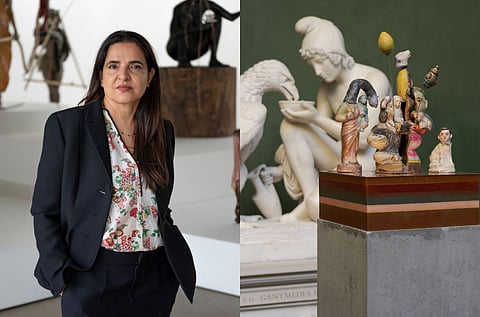
Bharti Kher has been called many things over the years — feminist icon, myth-maker, provocateur, chronicler of the female body — and she wears all of them lightly, almost playfully. Spend five minutes speaking to her, and you realise the labels have very little to do with the work. What she is really doing, and has been doing since the ’90s, is building an inner world brick by brick: one bindi, one pelt, one map, one hybrid body at a time.

Bharti Kher: Everything is different and the same. In the ’90s, I worked with an urgency, almost an impatience, to make sense of the world around me, to claim space, to make my language. Today I work with a slower, deeper attention. I have made an alphabet, and now I can write with it. The questions have grown more cryptic, perhaps, but the centre of gravity is the same. It’s me in the middle like a mind map. I’m still investigating the body, our histories, and our mythologies. I’m still chasing the chimeras; I’ve just learned to trust that looking for them is the journey, and art is the medium.
BK: What first drew me to it was its paradox of form and meaning: masculine and feminine at the same time: a humble, everyday, mass-produced object, yet resonant, intimate, and symbolic. Profound and yet simple, the dot on the forehead carries cultural meaning, faith, and the possibility of tapping into your consciousness. Over time, the bindi became my own visual vocabulary, a way to build surfaces, maps, skins, and constellations. I’m no longer making bindi-panel works and have returned to painting after a 25-year hiatus. Even so, the quiet intensity of that small mark remains with me, a reminder that the simplest forms can hold entire worlds. I made the bindi works for 20 years, creating my own language that I could tap into whenever I needed to.
BK: I am an Indian artist, a British artist, a global artist, a female artist, an artist full stop. All those labels are true and insufficient at the same time. I’m water, fire, earth, air, atoms, molecules, energy, and stardust. So is everyone else.
BK: Markets crave certainty; artists work with uncertainty. My job isn’t to perform identity but to excavate it, challenge it, distort it. If the audience expects one kind of “Indian-ness,” I’m more than happy to offer them a completely different, unruly one.
People often approach India as a singular narrative rather than a constellation of contradictions. I remind people that London to Moscow is the same distance as the north and south of India. They look for “meanings” that are fixed or about something that can help them understand the subcontinent, when the work is really about paradox or the vastness of ambiguity and meaning. Misunderstanding is inevitable, though - it can even be productive. What matters is whether the viewer is willing to sit with not knowing and be open to that visual experience.
BK: A good day has both. I love the solitude to think and the teams to activate the work. The studio is a living being; some days she sings, some days she sulks. The important thing is to show up for her since I serve her and work to her rhythm.
BK: Protect your time - even the small stretches of 30 minutes are a chapter or a drawing. Grow your curiosity like a plant that you love. And don’t be seduced by speed and big promises from others. A long career is built slowly, with courage, discipline, play, and a willingness to fail and bounce back from inevitable crashes. Art is really important in your life, but it isn’t your life. Read philosophy, The Stoics, Confucius, Buddhist teachings, and Eastern philosophy that remind you of all of the above. Also, have fun.
BK: Conversations with friends, long walks, mythology, anthropology, odd encounters—all of these feed the work. I’m learning that the simple things in life are the hardest to catch. Everything eventually sediments somewhere beneath the surface. Art is a slow burn.