
Subscribe
Subscribe
- Motoring
- Style
- Home & Design
- Travel
- Food & Drink
- Specials
- News & Tech
- Videos
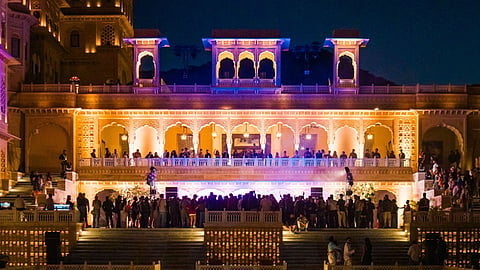
In Khetri, Rajasthan, the Aravallis do not announce themselves dramatically. They rise gently, almost discreetly. And then, suddenly, on a hilltop Abheygarh appears. The first glimpse of the heritage retreat is almost theatrical — a sandstone citadel glowing honey-gold against scrubbed blue skies. Turrets and chhatris punctuate the skyline. Arched corridors frame the hills beyond. It feels like being let into a palace that has quietly updated its operating system. Abheygarh is built for that kind of ambition.

I arrived as Nomads — the new, more intentional offshoot of Magnetic Fields music festival — was about to begin its first edition here from February 13-15, 2026. Magnetic Fields, in its original form at Alsisar Mahal, had always been about collision: Heritage architecture and forward-thinking sound. Nomads, I was told, would be different. Slower — more porous, more human.
The palace itself is a study in detail. Hand-painted frescoes bloom across ceilings. Stained-glass windows fracture the desert sun into jewel tones that fall across marble floors. Every corridor seems to end in a quiet surprise — a carved alcove, a marble jaali, a terrace that catches the wind just right. At night, lit softly from within, the structure glows like a lantern set atop the hill.
But what struck me most was how alive it felt once the music began. On the first afternoon, I wandered towards the Jameson Connects West Stage, set against the rolling green of the Aravallis. It was here that the desert met electronica. Malian singer Vieux Farka Touré, often called the “Hendrix of the Sahara,” coaxed spirals of guitar into the warm air, while later Rival Consoles unfurled a live A/V set that felt almost architectural in its precision. The sandstone walls seemed to absorb the bass and release it back into the dusk.
In another part of the palace, the BUDx East Stage throbbed with kinetic energy — selectors like Mafalda and D. Tiffany guiding dance floors through soul, house, and leftfield excursions on different days. The sound-and-visual provocateur Varoon Nair aka “Squidworks”, alongside Dutch-Moroccan DJ and producer Elias Mazian — whose warm, transportive selections have a way of quietly igniting dancefloors across the world — kept guests perpetually on the dancefloor. But Nomads is not built purely for velocity.
One night, I slipped away to The Stepwell — India’s first-ever dedicated ambient and downtempo stage within a festival setting. Here, the mood shifted entirely. Barker sculpted a live ambient set that felt devotional, each note expanding gently into the desert sky. There was no frenzy, no phones raised high. Just bodies reclined against cool stone, listening. It felt radical — to create space for stillness at a music festival. That, I realised, was the thesis of Nomads.
Beyond the stages, Abheygarh revealed its other lives. In a stained-glass room shimmering with gold leaf, Letters Across Time invited guests to sit and handwrite notes — not texts, not captions, but letters. Each one framed and displayed, forming a growing archive of longing and memory. It was disarmingly intimate. At the Lovebirds Pavilion Circle — an open, circular structure at the heart of the grounds — strangers gathered without agenda. It was like a meeting point — no performance, just presence. In the Sanctuary, co-curated by psychologists and sound therapists, sharing circles and workshops unfolded daily, spilling conversations about identity, mental health, harm reduction. I had never before seen a festival integrate welfare so seamlessly into its architecture. It wasn’t an afterthought; it was embedded.
There were tactile interventions, too. A Wabi-Sabi clay workshop invited guests to shape imperfect vessels by hand, guided by the philosophy of impermanence. Heart Notes, hosted by perfumer-poet Jahnvi Lakhota Nandan, blurred scent, poetry, and ritual into something that felt almost time-bending. In another wing, Puqaar Music Diaries screened a documentary preserving Rajasthan’s endangered folk instruments — a reminder that innovation and heritage need not exist at odds.
And then there were the rooftops. At the Corona Sundowner stage, as light softened into amber, sets by artists like Auntie Flo and 1-800 GIRLS floated over the forests surrounding Khetri. From that vantage point, the festival felt less like an event and more like a temporary city — one built on intention rather than excess.
Nomads was born, according to its founders, from a desire to move away from over-stimulation and over-consumption. Standing there, watching dancers framed by domes, I understood the ambition. This was not about stacking headliners. It was about building community — bridging folk musicians and electronic producers, vinyl collectors and ambient experimenters, desert storytellers and Berlin radio hosts.
Magnetic Fields has always prided itself on bridging worlds — classical and contemporary, rural and global. Nomads extends that philosophy into something more immersive. Moving Stories, for instance, took small groups beyond the palace walls by gypsy into the surrounding landscape, where history and memory became part of the performance. No two journeys were the same. You returned not with facts, but with resonance.
As I walked back to my suite one evening, the palace was quiet for a moment between sets, and I paused under an archway. From one direction, bass hummed faintly. From another, laughter drifted up a stairwell. Abheygarh, perched on its hill, felt like a living organism — sandstone and sound, fresco and frequency. Every nook held a possibility. Every corner, a conversation.
In an age of maximalist festivals and algorithmic lineups, Nomads at Abheygarh offers something rarer: A recalibration. A reminder that music can be immersive without being overwhelming. That heritage can host the future without losing itself. That a palace on a hill in Rajasthan can, for three days, become the centre of a quieter, more conscious cultural movement.