
Subscribe
Subscribe
- Motoring
- Style
- Home & Design
- Travel
- Food & Drink
- Specials
- News & Tech
- Videos
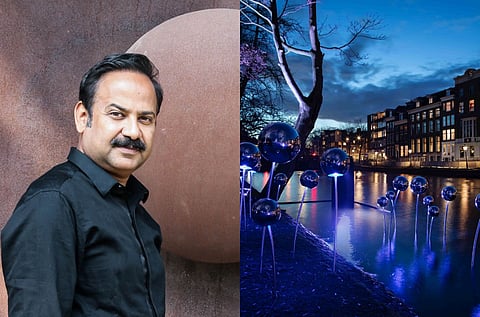
Vibhor Sogani loves the moment of connection when someone who is not seeking art suddenly stops and engages with a work—on their terms. That human response, subtle as it may be, is what he values most. He believes that art should touch the human experience in some way.
Sogani is an internationally acclaimed artist, known for his public installation works. His acclaimed “Mahatma in Me” series reimagined Gandhian philosophy and travelled from India to Africa, to Australia, adapting to different culturaland political contexts, while also acquiring new meanings.
His works can be experienced in cities such as Delhi, including “Sprouts” located near the AIIMS flyover, “PM Vishwakarma” at the Yashobhoomi Convention & Expo Centre, “Mahatma” in Satyagraha Marg, and “Kalpataru” at Motilal Nehru Marg. “Map Vadnagar” is housed in the Vadnagar Archaeological Experiential Museum in Vadnagar, Gujarat. “Kalpavriksha” and “Rhythm” can be seen at the Arvind Uplands in Ahmedabad, while “Peepal” is set against the architectural grandeur of the Tijara Fort Palace in Rajasthan.
“What draws me towards public art is its democratic nature. It belongs to everyone—someone passing by on a bicycle, a family out for a walk, or a child simply looking up. That inclusivity shifted my practice from designing products to shaping experiences. And that intent continues to guide my practice today,” says Sogani.
The artist believes that public art isn’t created only for those who follow or understand art and that it is for everyone who encounters it, intentionally or by chance. “Even someone who has no prior connection to art should feel an instinctive pause or a moment of curiosity,” he says.
RR India speaks with him about his journey so far, his experiences showcasing his work outside the country, and his design philosophy.

Vibhor Sogani (VS) : My early years were shaped by a disciplined understanding of form, material, and function, as I’ve studied industrial design. Along the way, I felt the boundaries of product-scale work closing in. I wanted to work with space, not just objects. I wanted to see how form behaves when it breaks free of walls and enters the public realm. The environment I grew up in, my childhood observations including how light moves across a surface, how people gather around something unfamiliar—those cues became the foundation for my work.
VS: Spatial sculpture in India is at an intriguing crossroads. The increase in private commissions and luxury-centric installations is noticeable. However, it only captures one facet of this artform. A deeper cultural and urban narrative is emerging, one where public art and installations are beginning to participate in conversations around identity, public memory, and the character of our shared spaces. Spatial sculpture can anchor a neighborhood, humanise large developments, create moments of pause, and give a city its emotional vocabulary. Looking ahead, I believe the trajectory will move toward more integrated, civic-oriented public artworks that are not only commissioned for impact, but for meaning. Interdisciplinary collaborations will become more common and sculpture will increasingly be seen as a tool for placemaking, storytelling, and elevating urban experience rather than simply as a marker of luxury
VS: For me, bridging Indian culture with a global design language isn’t always about using obvious symbols or trying to ‘translate’ India literally. It’s more about the energy and our values that shape how we live and interact. A lot of my work comes from India’s long history of public spaces and festivals. These are occasions and spaces where people naturally come together whether to share ideas or celebrate. There’s a sense of community in that. I try to take that feeling and express it through a contemporary, universal language. Whether it’s a small lamp in a gallery or a large-scale urban installation, I want the gesture to carry a sense of India’s spirit, even as it speaks a language that’s globally relatable.
VS: Platforms like the Amsterdam Light Festival and Dubai Design Week allowed me to explore two very different urban contexts. Amsterdam gave me the chance to work with water, light, and reflection: elements that naturally soften a space. Installations such as the Pool of Dreams and Deepam were designed to create quiet, contemplative moments. Dubai offered an intense, fast-paced environment where light became a tool to re-centre the observer. Both experiences taught me how cities shape the way people respond to art.
VS: The experience of representing India at the London Design Biennale was insightful. Instead of a physical installation, I presented a film—a two-dimensional medium—that paradoxically allowed me to reveal far more of the principles that guide my work than the three-dimensional medium that I work in. It offered a rare lens into my process: how ideas take shape, how materials behave, and how spatial experiences are conceived long before they are made tangible. Showing this work in the historic setting of Somerset House created its own dialogue. The contrast between an architectural canvas and a contemporary, process-driven film made the experience powerful. How people responded to the film was especially interesting.