
Subscribe
Subscribe
- Motoring
- Style
- Home & Design
- Travel
- Food & Drink
- Specials
- News & Tech
- Videos
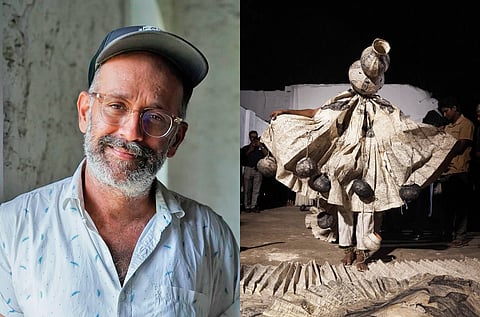
Curator of the sixth edition of the Kochi-Muziris Biennale Nikhil Chopra has collaborated with HH Art Spaces, a Goa-based artist-run collective and movement, to co-create an exhibition that he hopes is responsive, alive, and continually evolving, thereby resisting the pressures and expectations of a more conventional biennale.
Chopra, who co-founded the collective that works with performance, visual, sonic, and installation artists says, “We have become the space—or set of people—who are invited to activate the ‘live’ aspect of exhibitions. We were part of the Invitations Programme at the fifth edition of the Kochi Biennale, so it naturally flows into looking at what we do as an art space.”
Titled For the Time Being, the sixth edition of the Biennale will open on December 12, 2025 and will run until March 31, 2026. Chopra shares more.

RR: What is your vision for the Kochi- Muziris Biennale?
NC: It’s not really one vision. Instead, it’s a very layered set of invitations. We’ve relied on HH Art Spaces, and the work we’ve been doing as a team for 10 years. In the past, we’ve organised exhibitions, performances, residencies, curatorial projects for the annual Serendipity Arts Festival in Goa, and the India Art Fair in New Delhi.
One thing that we do is work with the body. We’re interested in performance, liveness, aliveness. We’re interested in engaging with the presence of the artist, whether it’s through their artwork or in the flesh.
Also, because we’re all artists, we [have thought about] how we can use our research to invite performance projects. The idea is to create a dynamic Biennale.
And, of course, there’s the context of Kochi, and the rich and layered history of the place. It’s also about the history of the spaces that we occupy, such as the warehouses. We’ve looked at it from a critical lens—[through] the history of colonialism, industry, large-scale trade, commerce, and power. The warehouses that [the artists] are occupying at the Biennale have a lot of resonance, so it’s also about reacting to the conditions. There’s a lot of artistic practices that work with material and tactility, smell, and touch. There are many “life” pieces and performances as well.
RR: What is the impact you hope to create with the Biennale?
NC: Firstly, it’s a Biennale of healing, and healing on many levels. Even on an international level, if you look at the state of the world... ecology and politics, it’s in a mess. So, it’s a moment for us to pause and look at what we do. It’s important to use this moment in a safe place like Kochi, to come together from all over the world, and take a moment to immerse ourselves in art projects.
I think that the Biennale needs to heal as well—there have been bruises and heartbreaks. I think it needs to take this moment to reckon with who it is, what is its purpose. That said, at the end of the day, the Biennale has always delivered. The quality of the work that previous curators have brought out has always been outstanding. It’s a responsible exhibition and it needs to figure out how to sustain itself.
RR: Tell us about the exhibits…
NC: [We have artists] coming from across the world—from the Republic of Congo, South Africa, Brazil, Argentina, Sri Lanka, Indonesia, Singapore, Cyprus, Germany, the U.K., and Norway. We have invited Indian artists from Baroda, Ahmedabad, Patiala, Guwahati, and Kolkata. You’ll be asked to engage with a lot of senses. There’ll be plenty of places to rest, relax, and lie down. This Biennale will need time—three to five days is a good amount of time to spend here. I hope it touches people and that they are moved and think about it... that it has a certain potency that stays like a fragrance that lingers. We’ll wait to see how it unfolds over 110 days.