
Subscribe
Subscribe
- Motoring
- Style
- Home & Design
- Travel
- Food & Drink
- Specials
- News & Tech
- Videos
AI generated summary, newsroom reviewed
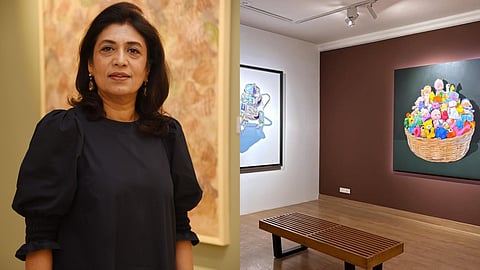
Founded in 2001, Art Alive Gallery is a contemporary art space in New Delhi which is celebrating its 25 year milestone this year. Its founder and director, Sunaina Anand, observes this auspicious event in time with a reflection of a long and enriching journey that has unfolded alongside the rise of India's contemporary art ecosystem. What began as early as 2001, ensuing from a mere instinct clubbed with conviction, has grown into one of India's leading platforms, representing modern masters and contemporary artists alike, while also championing publishing, scholarship and institution-building.
In an in-depth conversation about her journey with Robb Report India, Anand look into the rear-view mirror and shares her thoughts on the evolution of Indian art market, the changing tastes and profiles of collectors, the importance of documenting art history and why it is imperative for commercial galleries to serve a larger cultural purpose, among other things. Chiefly, she also comments on Art Alive's landmark anniversary exhibition Shots in the Dark, a solo exhibition by Chandra Bhattacharjee. Parts of the conversation with the gallerist are produced here as an interview.
Sunaina Anand (SA): I came from the creative field. Being a graphic designer, going to galleries and museums was always a part of my being. Visiting museums and galleries was something I naturally gravitated towards and, over time, I felt drawn to engage more deeply with the field. Founding a gallery became the most natural way of engaging with art.
One instinct that has remained constant over these 25 years is my personal response to art. Every artist we work with begins with that instinctive connection. Before it becomes a professional decision, it is always a personal response. If I genuinely respond to an artist's work, I want to understand the practice more deeply and eventually present it through the gallery. That instinct still guides me today. Whether I am looking at the work of a younger emerging artist or an established master, I continue to trust my own response to the creativity before me. It is that instinct that has shaped the artists we have chosen to work with and, ultimately, the identity of Art Alive Gallery.

SA: The Indian collector base has evolved tremendously since we started the gallery in 2001. The collector base itself has grown significantly, but more importantly, so has the understanding of art. Today there is far greater access to information. People have more to read, more exhibitions to visit, more spaces to engage with and much greater global exposure. All of this has contributed to creating collectors who are far more informed and deeply engaged with art than they were 25 years ago.
Earlier, there were fewer collectors and many collected primarily because they were drawn to a particular artist or work. Today, collectors often come with a more structured mindset, with a great deal of research behind them. They have already explored an artist's practice, read about their work and developed their own perspective before they enter the gallery. There is a certain kind of dialogue that has emerged. Conversations with collectors today are much richer; they want to understand an artist's journey, the context behind a work and the ideas that shape a practice. The engagement is no longer limited to acquiring a work of art or simply discussing its commercial aspects; it is about understanding the artist and becoming part of a larger conversation around art.
SA: A legacy is definitely formed when working with senior masters. These are artists whose practices are rooted in history and have made a significant contribution to Indian art—indeed, they have shaped Indian art as we understand it today. Personally, I have always been drawn to our artistic traditions and aesthetics, so that legacy has always been an important part of the gallery's vision.
At the same time, it has been equally important for us to explore practices and mediums that deserved to be brought into the contemporary gallery space. I remember when we presented the Jangarh Kalam exhibition in 2010. Ours was among the first private white cube gallery spaces to bring tribal art into the mainstream contemporary gallery context. We later continued that engagement by inviting these artists into projects such as Living Walls, encouraging these practices to become further integrated into a wider contemporary dialogue. Today, these practices are widely engaged with, but back then it was not common for tribal art to be present in such spaces.
From the beginning, Art Alive has believed in presenting different artistic traditions alongside one another. Indian art has never been about a single aesthetic or a single narrative. It reflects the immense and vibrant cultural diversity and heritage of our country. That is why we have always enjoyed engaging with these parallels, placing miniature traditions alongside contemporary practices, tribal art within contemporary discourse, or presenting artists whose work draws inspiration from these rich visual histories. Those conversations continue to shape the gallery even today.
Over the years, these beliefs have shaped a programme that brings together senior masters, mid-career contemporary artists and younger art practitioners from diverse backgrounds. For us, legacy and discovery have always existed in dialogue with one another.
SA: I believe Indian contemporary art is taken very seriously on the international stage today. That recognition has come through the collective efforts of many people and institutions—private galleries, museums, institutional collaborations, international art fairs and the growing museum culture in India over the past decade.
The strength of the art itself has also made a huge difference in how Indian art is viewed on the global stage. Indian artists are deeply rooted in our own aesthetic and cultural traditions, yet their work speaks a contemporary language. That balance is what resonates with international audiences; it offers something that is both distinctive and universally relevant.
Today, I see far more opportunity than resistance. There is genuine curiosity about Indian art. We regularly receive museums and international institutions visiting India, and there is growing interest amongst international museums, collectors and auction houses across the world. The conversations are becoming deeper, and I think we are only going to see more international collaborations and greater visibility for Indian art in the years ahead.
SA: Publishing has always been a very important focus for Art Alive Gallery. We are proud that we recognised its importance early on and began investing seriously in publishing at a time when very few private galleries were thinking about documenting artists' journeys in a meaningful way.
For us, publishing has never been limited to documenting the artists we represent. It is equally about documenting the journey of Indian art itself and giving back to the industry. If Indian art is to gain greater understanding and recognition internationally, it must be supported by serious research, scholarship and documentation. That was one of the motivations behind publishing 20th Century Indian Art with Thames & Hudson, a project that sought to contextualise the evolution of modern Indian art through different perspectives and place it within a wider international discourse.
When we began the independent publishing wing, there was a significant gap in terms of research and documentation. Artists were being exhibited and their works were being sold, but very little thought was being given to preserving that journey for the future. Today, we recognise how valuable those early catalogues and publications have become. A published work carries greater historical significance because it becomes part of the documented record. These books are not only valuable today; they are resources that future generations will continue to refer to as they study the history of Indian art.
SA: I have always believed that the role of a gallery extends far beyond exhibiting and selling works of art. Galleries are, in many ways, cultural institutions. They have a responsibility to create awareness, build knowledge and contribute meaningfully to the larger discourse around Indian art. That responsibility has always guided my work, both within and beyond the gallery.
Delhi Art Week was an endeavour that grew out of that belief. As the capital of the country, Delhi has a vibrant artistic ecosystem. It felt important for galleries and institutions to come together as a community to celebrate and strengthen the city's position as an important cultural centre. It was a collective effort to bring greater visibility to Delhi as an art capital and encourage wider public engagement.
The Partition Museum was driven by a different but equally important purpose. The Partition remains one of the largest migrations in human history and yet it is living history, one that is gradually disappearing as most of those who experienced it firsthand are no longer with us. It was essential to document these stories before they were lost. The museum preserves not only historical records but also personal memories that help future generations understand a defining moment in our collective past.
For me, there is little separation between commercial galleries and public cultural infrastructure. Art reflects the society and the times we are living in. To truly understand an artist's work, we must also understand the history, culture and lived experiences that shaped it. If future generations are to appreciate artists such as Krishen Khanna or Satish Gujral and their responses to Partition, they must first understand the historical context from which those works emerged. Supporting institutions that preserve and interpret that history is therefore a natural extension of the role that a gallery, as a stakeholder, can and should play.
SA: 2026 marks the 25th year of Art Alive Gallery, and our programming for this landmark year began in January in a way that reflects both our journey so far and our vision for the future. We began the year with Shibu Natesan's solo exhibition, Mirror Man, Mirror Me, followed by Luminous Terrains, a major solo exhibition by Paresh Maity. We are currently presenting Chandra Bhattacharjee's Shots in the Dark, and will conclude the year with Maya Burman's solo exhibition in December. Apart from these major solo exhibitions, we are going to present a major group exhibition titled A Moment in the Monumental, curated by Kishore Singh at Bikaner House in September, which will reflect on the legacy of Art Alive over the past 25 years.
As a gallery, we have always believed in presenting artists with strong individual voices and powerful creative practices. The quality of the art has always come before anything else. We have never been guided by trends, but by originality, artistic integrity and work that has the ability to live beyond its time. Every artist we work with brings a distinct perspective, and that diversity has shaped the identity of Art Alive over the last 25 years.
Looking ahead, Art Alive Gallery will continue to be a space where people come not only to experience some of the finest contemporary Indian art, but also to develop a deeper understanding of Indian aesthetics and artistic traditions. Documentation will remain an integral part of that journey, contributing to documenting the larger journey of Indian art and building upon the work we have done over the last two decades. I hope that the next 25 years of Art Alive Gallery will be known not only for presenting remarkable exhibitions, but also for contributing to the scholarship, understanding and global appreciation of Indian art.
Shots in the Dark, a solo exhibition by Chandra Bhattacharjee, comes to Art Alive Gallery from August 1 - 20, 2026. The exhibition brings together a compelling new body of monumental charcoal drawings and watercolours.
Address: S-221, Gamal Abdel Nasser Marg, Block S, Panchsheel Park South, Panchsheel Park, New Delhi, Delhi 110017