
Subscribe
Subscribe
- Motoring
- Style
- Home & Design
- Travel
- Food & Drink
- Specials
- News & Tech
- Videos
AI generated summary, newsroom reviewed
Renowned as Japan’s “Sleeping Giant”, Karuizawa is renowned for being home to one of the whisky world’s most exclusive ‘ghost distilleries.’ It contains a potted history of decades of liquid gold. Over its brief 46-year existence and lack of recognition outside of its home market, the Karuizawa whisky has now grown to become a collector's paradise.
Although along with Scotch, American, and Irish whisky, Japanese whisky is counted among the top categories worldwide, the average Japanese bottle still costs a little more than the others. It is somewhat ironic then that Shinjiro Torii, the founder of Japanese whisky, intended for Japanese whisky to be a spirit that the average consumer could enjoy, but in actuality, Karuizawa has become one of the most rarefied and costly spirits in the world due to the unpredictability of recent whisky history as well as the combination of growing rarity and rising demand in recent years.
Daikoku Budoshun founded the modest and unassuming Karuizawa Distillery in 1955 on the southern slope of Mount Asama in the southern Alps of Japan. Like Scottish distilleries, Karuizawa initially produced whisky for the sole purpose of blending. It wasn’t until 1976 that Karuizawa produced its first single malt. Later on, the Mercian Corporation acquired Daikoku Budoshun and its distilleries in the 1960s. From then on, Karuizawa malts were mostly utilised in Daikoku Ocean blend whisky, with sporadic releases of single malts seeming to go unnoticed. Karuizawa had a sharp decline in consumer demand for whisky in the 1980s and 1990s following a decade of very unremarkable production. The distillery closed completely in 2011 after being mothballed in 2000.

The Karuizawa Distillery's site was special for several reasons. Firstly, the water source was extremely pure because it was located on the side of Mount Asama, an active volcano. Since it was the highest Japanese distillery, the average humidity was 80 per cent, and the temperature stayed steady at 10˚C. Older whiskies were highly concentrated due to the misty conditions, which promoted water evaporation before alcohol. The resulting liquid had the enviable ability to age gracefully for many decades, while retaining an abnormally high alcoholic strength and concentrated, complex flavour.
Furthermore, the unusually rich, nearly Scotch-like style of Karuizawa whisky was largely influenced by the mesoclimate of the region where it was produced. Karuizawa whisky's alcohol content remained relatively high because of the large daily temperature changes in the Japanese Alps, which contrasted sharply with other whiskies with a more stable environment. This produced the concentrated taste that a new generation of whisky enthusiasts were increasingly looking for.
Since the distillery is no longer functional, the place will never produce any fresh, original Karuizawa whisky. Because there are fewer surviving casks, supply continues to decline as demand increases. Every year, this makes every bottle that hasn't been opened rarer.
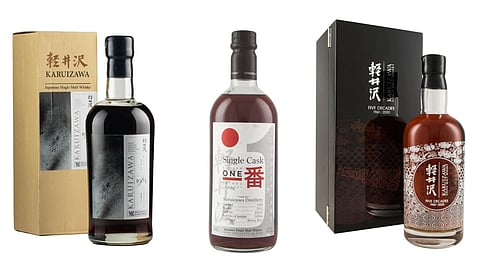
Due to the scarcity of both new and vintage Karuizawa single malt, buyers started searching the secondary market for elusive bottles, and auction houses all over the world were setting new records. When a single bottle of 52-year-old Karuizawa Zodiac Rat Cask was sold for USD 435,273 (INR 4 crore approximately) at Sotheby's in London in March 2020, it became the most expensive Japanese whisky ever sold at auction. This marked the peak of the Karuizawa craze. Additionally, this was the oldest bottle of Karuizawa single malt ever produced. These “collectors’ frenzy” bottles have now become a regularity at Sotheby’s, Bonhams, and private auctions as trophy collectables.
Karuizawa is now valued as an investment and treated like rare wine, art, and watches. Collectors, speculators, and traders of luxury assets from all over the world are among the list of buyers. It's also crucial to remember that closed-distillery whiskies acquire speculative value since demand is created by their scarcity and supply is permanently limited.
Aside from the uncommon angle of scarcity, the brand's vivid mythology and storytelling have drawn customers from all over the world. Mystique is increased by the romantic notion of a disappeared distillery close to an active volcano. The stories of the "lost distillery" provide cultural and mysterious prestige. Additionally, distinctive packaging, such as that of the Geisha series editions, enhances collectable appeal, making it a must-have for collectors.