
Subscribe
Subscribe
- Motoring
- Style
- Home & Design
- Travel
- Food & Drink
- Specials
- News & Tech
- Videos
It would be challenging to speak of one of the world’s most famous single-malt Scotch whiskies without referencing the Macallan Estate that lies just outside the village of Craigellachie, near the town of Aberlour in Moray, Scotland.
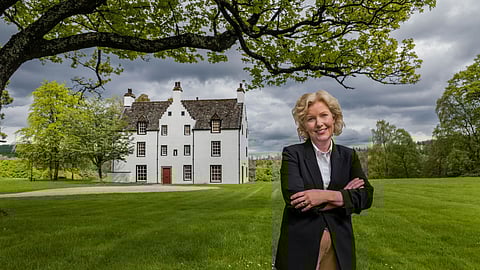
The 485-acre estate has two and a half kilometres of the River Spey running through it and is home to dozens of species of birds, fish, and wildlife, as well as the Easter Elchies House. The image of the three-storey manor built in the 17th century that serves as the “spiritual home” of the brand and is currently a residential building, features on the label of every bottle of The Macallan.
We spoke with Rachel Walters, operations director at The Macallan, who has worked with the brand for over 26 years. No stranger to India, Walters visited Kerala in 2024 with family. “I had some really wonderful fish, gently spiced—just some of the best fish I’ve ever had in the world.”
When asked about her earliest memories of whisky, Walters recalls Sundays spent with family. “When I was very young, I have memories of sitting on my grandfather’s knee, [who] would have a whisky after Sunday lunch. I’ve always associated Scottish whisky with these very warm memories of relaxation, good food, and of time with the family.”
Reflecting over her long association with Macallan, Walters says that she has learnt to take the long-term view. “Don’t worry about today. Don’t panic about the little things. Think of legacy. Look forward always, never backwards,” she says.

Rachel Walters ( RW) : The Macallan Estate is our home; it’s our birthplace, and we’ve been here hundreds of years. We had our license to make whisky in 1824—201 years [ago], but our history and our legacy in the state goes back even further than that. The famous Easter Elchies House that you see on the front of every bottle of the Macallan has the date stone of 1,700. So, we’retalking more than 300 years of legacy, at least. And our records go back further than that. So, there’s a real sense of legacy and heritage, and craftsmanship. We have these wonderful stories of our [owners] like Roderick Kemp sourcing Sherry casks way back from the 18th century. So, [there’s] that sense of continuity, of standing on the shoulders of giants. My job is to continue the traditions and the craftsmanship that have been going on for many generations.
Our fundamental methods of making the Macallan haven’t changed. We’re a little bit more modern in our technology and our safety procedures, and so on, but the fundamental quality points of the Macallan have stayed the same. I guess the other thing about the Macallan Estate is the beautiful Speyside location and that sense of the natural environment. We have two and a half kilometres of the River Spey on the estate and the salmon in the Spey, and the wildlife, the protected species, and the agriculture is key to our sense of place and our sense of who we are.
RW: What we try and do is immerse our guests in the story and in the legacy of what we do—starting with our sherry casks. We show guests around our distillery. So, although Ispeak about our hundreds of years of legacy, our new distillery building housing the traditional Curiously Small Stills is this award-winning Roger Stirk Harbour and Partners building from 2017, which is a spectacular statement of architecture.
We also like to immerse them in our natural environment. If they have the time and if they’re here in the summer, they can try fishing on the River Spey, which is a fabulous experience. We have our own kitchen garden and our own barley fields. So, you see the whisky-making process end to end. I like to say we have the whole process from the acorn to the glass; from the barley field to the bar.
We have a wonderful restaurant working in collaboration with (the three-Michelin-starred restaurant in Spain) El Celler de Can Roca and that tells the story of the Macallan on a plate. So, we have paired menus; paired with whisky or paired with sherry wine, we have a bar as well, so guests can try all kinds of tasting expressions. We’ve got the widest range of the Macallan expressions anywhere in the world—it’s wonderful to be able to show how we enjoy them and the different ways we serve the Macallan.
RW: Typically, Scotch whisky is matured in bourbon casks, so, let’s say, second-hand casks from the American whisky industry and that makes whisky in its own style. But we like to make our own casks and we season them with Sherry, but we go right back to the forest because we have our own sawmills, our own cooperages. So, we source oak from Appalachia, from the U.S.A, from, let’s say, Ohio, Pennsylvania, Kentucky. And we have our sawmills there. We also source oak in the north of Spain, in the very south of France. So, we have our sawmills in Cantabria and Asturias. So, we bring those logs, the staves, to our own cooperages, craft our butts and hogsheads: the different cask sizes and then season them with our own Sherry: dry Oloroso Sherry. So, right now, because we want to forest sustainably, we’re selecting logs and trees. They will dry for a year, get coopered into staves, dry for another year, be coopered into casks, and then be seasoned with Sherry wine, where they season for another year. So that whole process takes nearly five years—end to end. Right now, we’re making the casks and working on the process for the whiskey that will distill in 2030. I’m working on the 12-year-old for 2042 and the 18-year-old for 2048. It gives us a totally different perspectiveon time. We don’t rush anything. Everything we do is for the long term and the long game, but [what] those sherry casks give us is that that classic signature Macallan DNA. So, you’regetting with the Spanish oak, those classic rich dried fruit notes; with the American oak, the fresher, more tropical fruits, and the coconut, and vanilla. You get them from Sherry casks in a in a way that’s unique to us; the smoothness, the length of finish—that’s critical to what we do and that signature Macallan taste.
RW: There’s no right or wrong answer. I have the Macallan all kinds of different ways. I like the Macallan in a cocktail. I quite like a highball—a 12-year-old with some ice and somesoda as a long drink is wonderful. But my absolute favourite—I’m now 26 years working for the Macallan, so my favourite, these days, because I kind of, you know, I helped make this, is the Macallan 25-year-old, which tells my story with our wonderful whiskey—and I have that just neat in a nice glass.
RW: Absolutely! One of the other amazing things we have on the estate is our own bees, so we have our own beehives and our own honey—[the bees] make the most beautiful honey from the wildflowers on the estate. A special treat in the wintertime is [to take] a little bit of the honey, the Macallan 12-year-old double cask, and some hot water and, maybe, alittle bit of cinnamon, making sure that you can still get the Macallan flavours through... Oh my goodness! It’s the best winter warmer.
RW: Asian guests are more familiar with pairing whisky with foods. That’s not quite so common in Europe. India has a very rich tradition of whisky itself. When we’re introducing people in the Indian market to the Macallan, we’re not introducing you to whisky. You know all about whisky. You know more about whisky than we do! So, I think you can jump straight into more detailed conversation about different whisky-making types and practices, whereas sometimes in Europe or in North America, let’s say we’re talking to consumers that maybe drink tequila or drink beer or drink wine normally, so it’s a different conversation. Everyone has their own local traditions and that’s where it can be really fun. [Pairing] the Macallan with Indian food can be really exciting, as there’s some commonality and flavour in the spice. I would say European oak—you will definitely get on the nose, particularly some of the older variants. You will get cinnamon, nutmeg, star anise, and these wonderful flavours that can be beautiful to pair with foods. I think American oak whiskey can pair beautifully with Indian desserts. You can often get a very strong note of vanilla. And, I think, Indian vanilla, it’s the best in the world. A refreshing highball can work very nicely with Indian food as well.