
Subscribe
Subscribe
- Motoring
- Style
- Home & Design
- Travel
- Food & Drink
- Specials
- News & Tech
- Videos
Delhi has long known how to eat well, and that hardly comes as news to anyone. The capital's dining landscape is a confident and sprawling one. It has absorbed influences from across the subcontinent and beyond with equal appetite and discernment. And yet, one cuisine has remained conspicuously absent from any permanent address in the city.
Zetu, opening soon at 1AQ in Mehrauli, intends to change that by bringing in Sri Lankan cuisine, and on the evidence of our first visit ahead of its public opening, it does so with great conviction.

Between source and surface lies a quiet space, the point where experience begins to take form. It is here that attention settles, meaning emerges, and what is encountered becomes deeply personal. Zetu draws its name from this in-between passage: a space of memory and discovery.
This 175-seater restaurant is the vision of founders Sarah Nikahetiya, Anurag Dania, Sagar Garg and Abhishek Mathur, and the origins of the idea are personal rather than merely commercial. Nikahetiya, who is based in Colombo and married into a Sri Lankan family, speaks of the concept with the ease of someone who has been living inside it for years. It is this intimacy rather than a trend-chasing instinct that anchors what Zetu sets out to do.
At the centre of it all is the food. The kitchen is led by Sri Lankan Chef Dush Ratnayake, working in close collaboration with Indian chefs Mohit Kumar and Romil Malhotra. This is a deliberate and considered partnership that brings Sri Lankan authority into productive conversation with local technique and sensibility. When we sat down with Chef Dush ahead of opening, he was candid about the decisions that shaped the menu. Dishes that might blur too easily into South Indian territory, like the appams, the rasams, have been set aside. "I wanted to highlight the differences," he explains, "and position Sri Lanka as a unique cuisine." It is a confident decision and one that lends the menu its own clarity.
Lamprais, arguably Sri Lanka's most storied preparation, with its Dutch Burgher origins and its intricate composition of rice, meat, sambols, and spices, is approached here with painstaking precision. Kiribath, the ceremonial rice dish, arrives with a sense of occasion intact. Hoppers and kottu roti sit comfortably alongside smaller plates, while a guava pie closes the meal with a modern interpretation of something that feels entirely rooted in place.
The bar, too, earns its attention. Cocktails are built around Sri Lankan ingredients and flavour profiles like coconut, curry leaf, and smoke. A parallel zero-proof menu explores adaptogenic and protein-led drinks. The drink programme at Zetu takes the cuisine's identity very seriously.
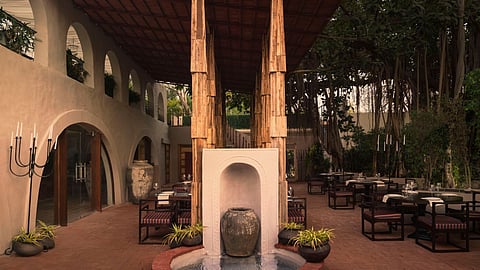
The space is the work of co-founder Anurag Dania, and it draws, by his own account, from the architectural language of Geoffrey Bawa and his contemporaries. The restaurant unfolds across three distinct zones, each calibrated to a different rhythm of dining.
Light is filtered, thresholds are intentional, and over 500 plants are woven throughout the interior, with a banyan tree forming its centrepiece. The place breathes at its own pace, and after a few minutes, so do you.
Zetu reflects a broader shift in Delhi towards experience-led, edible storytelling. If you like food that tells a story, this one might be worth your weekend.