
Subscribe
Subscribe
- Motoring
- Style
- Home & Design
- Travel
- Food & Drink
- Specials
- News & Tech
- Videos
Kimikai – Umami House, which officially opened its doors on March 28 at Two Horizon, Gurugram, takes its concept and food a tad too seriously. Inspired by an eponymous mythical fox in Japanese folklore, the restaurant offers a carefully staged fine-dining experience that reads more like a lived-in home than a restaurant.
The interior narrative ties to a single conceit. "Essentially, Kimikai is an opium trader. And she's disguised herself as a spice trader along the Silk Route," says Chef Ruhani Singh, the co-founder of the restaurant. Singh is a Les Roches graduate, who has trained in Le Cordon Bleu and is the ex-Chef at the famous Zuma Dubai. That story frames the design, the menu, and the service throughout. Robb Report India got an exclusive first access ahead of the restaurant’s official opening to the public.

The approach to the restaurant resembles entering a residence rather than a commercial dining room. As Singh explains, "This is Kimikai's house, and the plants carefully placed around the exterior along with the wooden fenestration aim to create a garden outside the house.” From displayed garments (there’s Kimikai's robe hung on the wall near the bathrooms) to wallpaper patterned with poppies (that refers to the opium trade) — the tone is intentionally cosy and domestic.
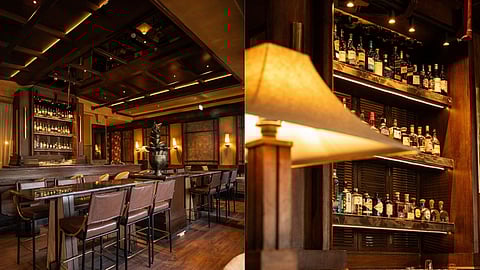
The space is organised to be adaptable and intimate. Retractable sliding doors allow areas to open up or be enclosed. A sushi bar with a long table and vintage lamps overhead makes the experience even more intimate. This is where diners can see the chef customising the sushi as per their palate. Adjoining the sushi bar is the private dining room, and the two can be easily combined for an intimate party. "If someone wants to book out the sushi bar and the PDR, it becomes one section,"says Singh.
Interiors make a generous use of dark wood and stone surfaces keeping the aesthetic rustic with tad of modern touch. The deliberately homely bathroom wallpaper reinforces the theme.
The food menu is conceptualised by Singh alongside Pawel Kazanowski — whose international experience has shaped contemporary Japanese fine-dining, and Mario Fico, former head chef at Zuma Dubai with a background spanning Asian and European kitchens. It stays focussed, drawing exclusively from South and East Asian cuisines.
Kimikai frames itself as an “umami house,” with dishes built around depth and balance. There’s a subtle Silk Route narrative running through it — spices, poppy motifs, and a sense of movement across regions — carried not just in the food but in the details. Even the uniforms and wallpaper are designed to echo that story, tying the space together without making it feel overly thematic.
I began the meal with a bowl of steamed edamame followed by tomato and salmon carpaccio — both clean, lightly dressed, and confident in their simplicity. Up next was avocado tempura, warm and crisp with a soft centre. The spicy tuna carried the expected umami depth without overcomplication. The crunchy brioche, in particular, was worth lingering on — whether topped with truffle mushrooms and peppers or pulled lamb with parmesan, each variation felt considered and the textures worked well together. The crispy fried squid was addictive, tossed in the house spice blend with a lingering heat.
The meal built momentum with heartier plates — the spicy chicken taco packed a punch without overwhelming. The yakitori followed, glazed in a glossy, house-made sauce that balanced sweetness and char. A citrusy chicken breast cut through with brightness — yuzu, grapefruit, and orange lending a refreshing lift — while the black cod, lacquered in a citrus miso glaze, was the kind of dish you return for, buttery and deeply satisfying. A baked potato with chilli basil butter added an array of textures and instantly became my favourite. I ended the meal with a matcha tiramisu — a gentle finale — restrained, elegant, and entirely in keeping with the experience.
The drinks at Kimikai arrive with the same intent as the food — structured almost like a tasting menu in liquid form. I went with the three-course cocktail progression. The experience began with Crush, built on Tanqueray No. Ten, sharpened with gherkin brine and lime cordial. The second, Smoke, made with Maya Pistola Añejo and a house maraschino-style liqueur. By the time Roll arrived, the progression felt complete. Ketel One forms the base, layered with myoga brine and Chardonnay.
Taken together, the three drinks echo the rhythm of a well-paced meal — starting bright, moving into something fuller, and finishing on a memorable note. There are quite a few interesting options like Bae of Bengal, Forbidden Fruit, and Golden Gambit that you can try if you aren’t in the mood for the three-course tasting menu.
What stayed with me, more than any single dish, was how cohesive the whole experience felt. At Kimikai, nothing seems accidental — the food, the room, the uniforms, even the way the service unfolds all point in the same direction. It’s a rare kind of clarity. The space doesn’t fall back on the usual playbook of polished minimalism; instead, it leans into detail and narrative, drawing you into its Silk Route thread without announcing it too loudly.