
Subscribe
Subscribe
- Motoring
- Style
- Home & Design
- Travel
- Food & Drink
- Specials
- News & Tech
- Videos
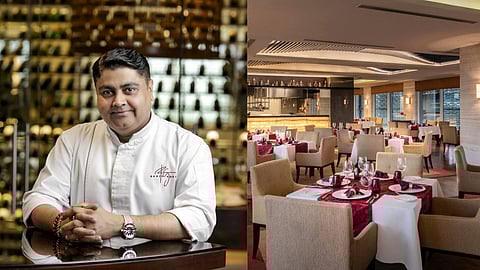
After nearly two decades in London, where he helmed Michelin-starred kitchens and helped redefine modern Indian dining for a global audience, Chef Rohit Ghai has returned to India with his latest restaurant. Zarqash at The Ritz-Carlton, Bangalore is a careful articulation of everything he has learned about technique, balance, and the evolving expectations of diners who are now as comfortable with fine dining in Bengaluru as they are in Mayfair.

Chef Ghai began his career with The Oberoi Hotels in India before moving to the UK nearly 19 years ago, where he went on to head the Michelin-starred kitchen Benaras. According to him, during his early days in a professional kitchen, international ingredients were scarce in India, standalone restaurants were few, and fine dining lived almost exclusively within hotels. London, by contrast, was expansive, competitive, and endlessly experimental. "It was a different world," he recalls.
That exposure reshaped his approach not away from Indian food, but deeper into it. Learning French techniques allowed him to see Indian cuisine differently, to refine without altering its soul. Braising, slow cooking, overnight cooking, and water-bath are some French techniques he uses across his kitchens. Today, he believes global diners are more receptive than ever to authentic Indian flavours, provided they are presented with clarity. “If you elevate presentation without losing flavour,” he says, “it’s a win-win.”
The name Zarqash loosely translates to something stitched with gold, hints at richness, but the menu is grounded in mindful structure. To articulate the restaurant’s identity clearly, Ghai has designed a signature tasting menu. It unfolds slowly, course by course, encouraging diners to experience Zarqash as a journey rather than a meal. “Using exotic ingredients like lobster, scampi, and truffle, but also ensuring there is a proper balance between vegetarian and non-vegetarian offerings.” The team emphasised local sourcing. “We support local producers, and that keeps the food honest as well as seasonal.” Dishes are drawn largely from the north and west of India—Punjab, Gujarat, Uttar Pradesh—with subtle influences from Kashmir.
What emerges most strongly is Ghai’s fascination with texture. A single ingredient, such as cauliflower, appears in multiple forms across a plate: roasted, stuffed, pickled, puréed, each preparation revealing a different character. A samosa, seemingly familiar, becomes a study in technique: cauliflower marinated and cooked in the tandoor, chopped and folded into parcels, paired with chutney and pickle, both made from the same vegetable. “It sounds simple,” he says, “but there’s a lot of effort behind it. I like people to experience different textures in one dish.” This respect for technique—particularly those borrowed from European kitchens—is one of the defining markers of Ghai’s cooking.
The same approach defines Zarqash’s meat dishes, none more so than the Kala Masala Chicken, already emerging as a signature. Twenty-six whole spices are deliberately burnt in oil until blackened, blended into a dark, smoky paste, and applied to chicken that has been simply marinated with ginger, garlic, lime, and salt. The bird is roasted in the oven for 25 minutes and served with a chicken bone marrow sauce, carved tableside. Designed to be shared, the dish is dramatic yet simply delicious!
Dessert at Zarqash offers perhaps the clearest expression of Ghai’s bicultural culinary voice. One of the most popular is the Trio of Classic, a sort of reimagining of three beloved Indian sweets: besan ladoo becomes the tart shell, miniature gulab jamuns form the filling, and the topping is shrikhand. This dessert, now a signature across a few of his restaurants in London as well, is a definite crowd favourite.
Beyond the restaurants, Ghai continues to document his culinary thinking through books. His first book, Tarkari, focused on vegetarian and vegan cooking. His latest, Yatra, is a culinary journey across 10 regions of India, featuring 108 recipes. Written in the margins of a busy international career, often in the early hours of the morning, the book is both personal and archival. “It’s about travel, roots, and regional food,” he says. “Each chapter has starters, mains, desserts, and drinks.”
Despite Michelin stars and international acclaim, Ghai’s own comforts remain simple. His favourite street food city is Delhi, specifically Chandni Chowk, for chaat and chole bhature. The one dish he could eat for the rest of his life? “Makki ki roti and sarson ka saag made by my mother.”